




Description
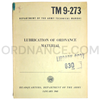
Technical Manual (TM 9-273) for Lubrication of Ordnance Material January 1962
This Technical Manual TM 9-273 covers Lubrication of Ordnance Material and is dated January 1962. For collectors of U.S. Army technical manuals, ordnance maintenance references, Cold War-era military publications, and dated government documents, this is a strong period piece tied to one of the most important areas of military equipment support: proper lubrication and preventive maintenance.
Issued during the Cold War period, this manual reflects a time when the U.S. military maintained extensive technical literature for every part of the ordnance maintenance system. Lubrication was a basic part of preventive maintenance, helping keep vehicles, weapons, artillery, fire-control equipment, and other ordnance materiel serviceable in field, shop, and depot environments. A public listing of TM 9-273 identifies it as a Department of the Army technical manual published in January 1962 and describes it as providing lubrication information for ordnance personnel.
Lubrication of Ordnance Material
The subject matter covered by TM 9-273 belongs to the broader family of ordnance maintenance, preventive maintenance, field service, and Army shop-support documentation. Rather than focusing on one single weapon, vehicle, or piece of equipment, this manual addresses the lubrication principles and practices that applied across multiple categories of ordnance materiel.
This makes the manual especially useful from a historical standpoint. It documents the support knowledge behind the equipment rather than only the equipment itself. Proper lubrication was essential to reducing friction, limiting wear, protecting working parts, supporting reliable movement, and maintaining readiness across a wide range of military systems.
For collectors, that gives this manual added appeal. It represents the practical maintenance side of Army operations and fits especially well in collections focused on ordnance support, Cold War maintenance manuals, Army shop practices, vehicle maintenance, artillery support, small-arms maintenance context, fire-control equipment, and U.S. military technical publications.
What This Manual Covers
As a technical manual for Lubrication of Ordnance Material, TM 9-273 would have served as an official Army reference for lubrication theory, lubricant selection, maintenance practices, and equipment-specific lubrication context.
In practical terms, a manual like this is especially relevant for:
- friction and lubrication fundamentals
- bearing types and bearing lubrication
- lubricant properties and additives
- lubrication equipment reference
- automotive materiel lubrication context
- artillery materiel lubrication reference
- missile equipment lubrication context
- fire-control and detecting equipment support
A public table of contents for TM 9-273 lists chapters covering fundamentals of friction and lubrication, bearings and lubrication, lubricants, lubrication equipment, automotive materiel, artillery materiel, missiles, fire-control and detecting equipment, small-arms materiel, and weather conditions.
Historical Significance
The date January 1962 places this publication in the Cold War period, when the U.S. Army relied heavily on technical manuals to standardize maintenance, inspection, training, and equipment-support practices. During this period, the Army maintained detailed reference material not only for weapons and vehicles, but also for the procedures and materials required to keep them serviceable.
For collectors and historians, this manual is especially relevant to subjects such as:
- Cold War U.S. Army technical manuals
- ordnance lubrication and preventive maintenance
- military vehicle maintenance references
- artillery maintenance and support documentation
- fire-control and detecting equipment support
- small-arms maintenance context
Because it covers lubrication across broad categories of ordnance materiel rather than one more common rifle, vehicle, or artillery item, this manual adds strong technical depth to collections that already include standard ordnance, maintenance, or field-equipment manuals.
About This Manual
This listing is for Technical Manual TM 9-273 for Lubrication of Ordnance Material, dated January 1962.
It is especially well suited for:
- U.S. Army technical manual collections
- Cold War military paper collections
- ordnance maintenance and shop-support displays
- military vehicle and artillery maintenance reference collections
- fire-control and detecting equipment research libraries
- museum exhibits on Army maintenance and logistics systems
- archive and research libraries focused on U.S. military technical publications
This listing is for the manual only unless otherwise stated. No tools, lubricants, vehicles, weapons, parts, fire-control equipment, or additional accessories are included unless specifically shown or noted.
Why This Manual Matters
Many military manuals focus on rifles, vehicles, artillery, ammunition, or communications equipment. This one documents a different but equally important subject: the lubrication knowledge and maintenance practices that helped keep ordnance materiel functioning properly over time.
For collectors, it is a strong stand-alone Cold War technical manual with a specialized maintenance subject focus. For researchers, it offers a useful reference point for U.S. Army lubrication practices and preventive maintenance documentation. For museums, it helps explain the behind-the-scenes systems that supported materiel readiness, field maintenance, shop service, and long-term equipment preservation.
Because lubrication was central to the Army’s preventive maintenance program, TM 9-273 helps preserve the broader technical and logistical picture of military operations rather than only the front-line equipment itself.
Ideal For
This manual is a strong fit for:
- U.S. Army technical manual collections
- Cold War ordnance maintenance displays
- military vehicle and artillery maintenance collections
- Army shop and depot reference libraries
- fire-control and detecting equipment support collections
- museum and archival reference libraries
Pictures are stock images of our inventory. Unless otherwise noted, you will not be receiving the exact item shown in the pictures. The pictures are representative of the item's general condition. The item you receive might be slightly better, or worse, condition than was shown in the pictures.
Please visit our page about order lead times here: Order Lead Times