
Description
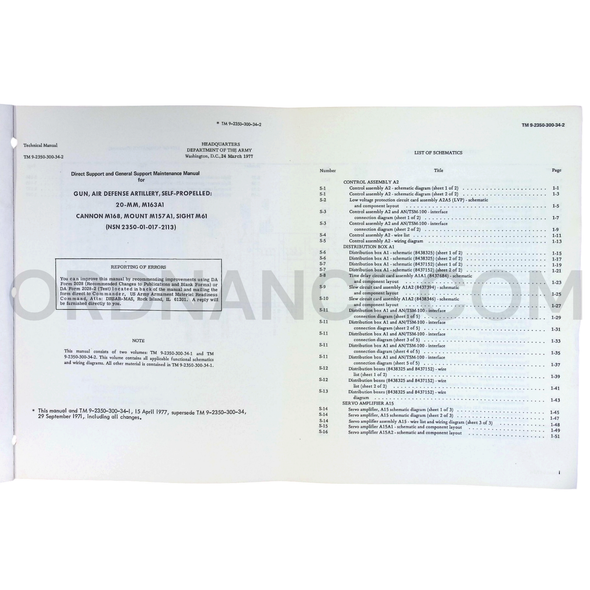
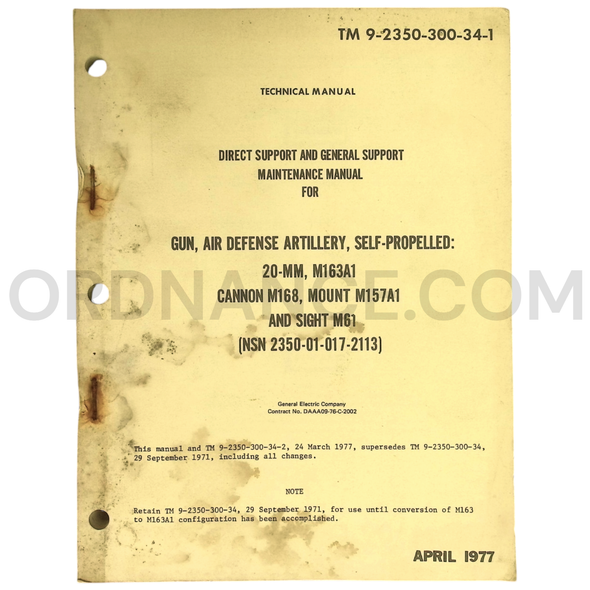
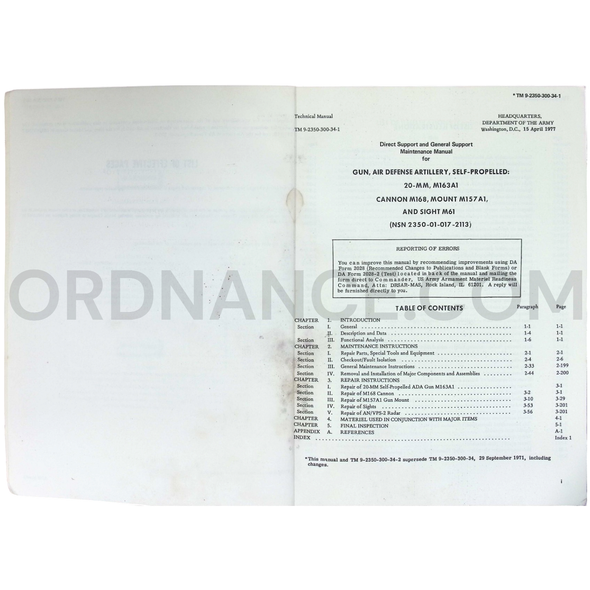
TM 9-2350-300-10 – 20mm M163A1 Vulcan Self Propelled Air Defense Artillery Gun Manual, May 1976
Publication Overview
TM 9-2350-300-10 is a U.S. Army crew manual for the 20mm M163A1 Self Propelled Air Defense Artillery Gun, part of the Vulcan Air Defense System. This May 1976 publication brings together operating and crew maintenance information for the tracked weapon and its supporting equipment.
Identification & Features
The manual number, vehicle designation, and included change level identify this publication within the Army's Vulcan technical manual series.
- Technical manual: TM 9-2350-300-10
- Base publication date: May 1976
- Equipment: 20mm M163A1 Self Propelled Air Defense Artillery Gun
- National Stock Number: NSN 2350-01-017-2113
- Publication role: Crew operation and maintenance
- Edition: Official reprint including current pages from Change 1
Function & Contents
The manual covers vehicle and weapon controls, normal operation, travel preparation, and operation in difficult weather. Maintenance subjects include lubrication, preventive checks, troubleshooting, and crew servicing. It also addresses ammunition identification and handling, radios, heaters, night vision equipment, and the auxiliary power unit. Its appendices cover publication references, basic issue equipment, operating supplies, and the locations of stowed items. This range of topics makes it a useful reference for studying the complete vehicle and the duties assigned to its crew.
Official Reprint & Change 1
This official reprint includes the current pages from Change 1 within the manual. It retains the May 1976 base publication date while presenting the text at the included revision level. That distinction helps collectors compare editions and follow Army references that cite the updated crew instructions.
Publication History
The base issue dated May 28, 1976 replaced the March 10, 1971 edition of TM 9-2350-300-10, including its changes. Earlier publications in the series documented the XM163 and M163 as the Vulcan program developed. This reprint belongs to the updated M163A1 phase of that continuing technical manual series.
Documented Applications
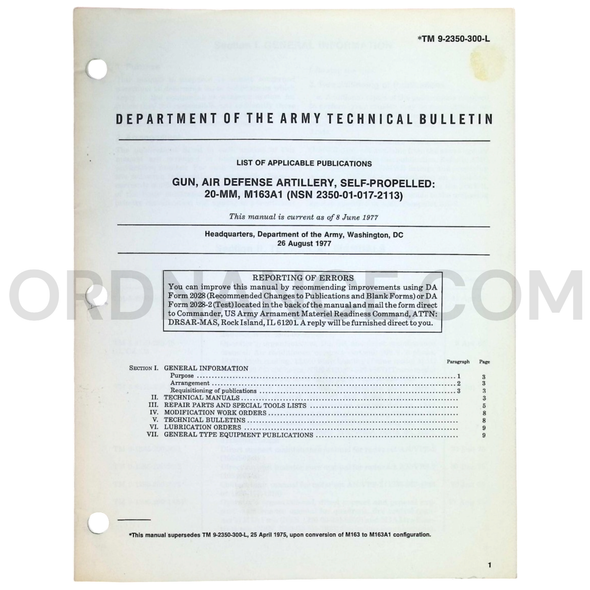
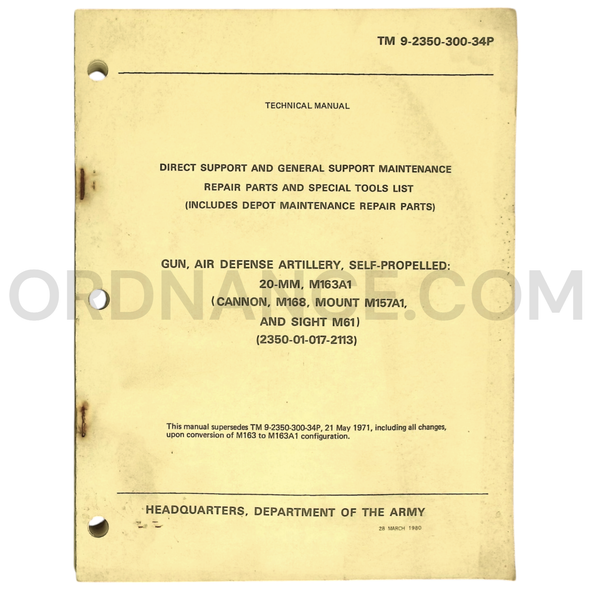
The listed application is the M163A1 under NSN 2350-01-017-2113, an identification also recorded by the Defense Security Cooperation Agency. Army maintenance publications for this configuration identify the M168 cannon and M157A1 gun mount, along with the M61 sight and AN/VPS-2 radar. These component names help researchers connect the crew manual with the equipment described in related service publications.
Equipment History
The Vulcan program grew from the Army's work during the 1960s to strengthen mobile air defense. After the Mauler program was discontinued, Vulcan became part of the effort to protect forward units. The early tracked system carried the XM163 designation before entering service as the M163. The M163A1 continued this family in an updated configuration, with its M157A1 gun mount documented in Army maintenance publications by 1977.
Parent Equipment History
The tracked Vulcan's carrier came from the M113 armored personnel carrier family, which entered service in 1960. Aluminum armor helped limit weight, and the M113A1 introduced diesel power. The same basic vehicle family supported mortar carriers, command posts, and other specialized Army equipment. Adapting this platform for Vulcan gave the gun cross-country mobility alongside the units it protected.
Weapon-System Background
The M168 is a six-barrel 20mm rotary cannon based on the Gatling principle. The Vulcan installation combined this gun with an optical sight and radar that measured target range. Its primary role was defense against low-flying aircraft. Vulcan and the Chaparral missile system served complementary roles in the Army's air defense plan near the front lines. The wider Vulcan family also included the M167 towed gun.
History of Manual Use
In June 1979, the Army's P.S. Magazine directed A1 Vulcan crews to Change 1 of TM 9-2350-300-10 for updated operating guidance. The article also cited that change for radar antenna stowage information. This contemporary reference connects the reprint's included revision to practical service guidance and shows how numbered changes helped keep crew instructions current.
Training History
Tracked Vulcans took part in Cold War field training as well as routine crew instruction. Army archival photographs document the M163 family during exercise REFORGER 85 in West Germany. A Defense Department photograph also records a Vulcan from the 24th Infantry Division at the National Training Center at Fort Irwin. These images document the family's presence in both overseas exercises and Army training centers.
History of Military Use
The family's early XM163 vehicles were evaluated in Vietnam during 1968 and 1969, serving on missions that included convoy protection, perimeter defense, and security for engineer work. This field experience preceded the M163A1 configuration. Later Vulcan vehicles remained part of Army air defense forces through the Cold War. The Army Transportation Museum also documents an M163 being loaded aboard USNS Bellatrix for deployment during Operation Desert Shield, showing the family's continued use beyond the period of this manual's base issue.
Ideal For
This manual suits collections focused on M163A1 vehicles, Vulcan air defense equipment, and Cold War Army publications. It is also useful for restoration research, comparing crew and maintenance references, or preparing a museum display that explains the vehicle's controls, equipment layout, and service role.
- Military technical manual collectors
- M163A1 owners and restoration researchers
- Cold War air defense historians
- Museums preparing Vulcan vehicle displays
Approx length 6.5", Approx width 9.5", Approx height .75", Approx weight 1.5lbs.
Pictures are stock images of our inventory. Unless otherwise noted, you will not be receiving the exact item shown in the pictures. The pictures are representative of the item’s general condition. The item you receive might be slightly better, or worse, condition than was shown in the pictures.
Please visit our page about order lead times here: Order Lead Times.