


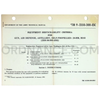
Description
TM 9-2350-300-ESC – 20mm M163 Vulcan Equipment Serviceability Criteria Manual
Publication Overview
TM 9-2350-300-ESC is a U.S. Army Equipment Serviceability Criteria manual for the 20mm M163 Self Propelled Air Defense Artillery Gun. This May 1974 edition belongs to the support publications for the Vulcan Air Defense System. Its focus on equipment condition makes it a period reference for studying how the Army assessed the readiness of this mobile gun system.
Identification and Features
These details identify the publication, its purpose, and the equipment associated with the listed stock number.
- Publication: TM 9-2350-300-ESC.
- Manual type: Equipment Serviceability Criteria.
- Equipment: 20mm M163 Self Propelled Air Defense Artillery Gun.
- System name: Vulcan Air Defense System, or VADS.
- Publication date: May 1974.
- Equipment stock number: NSN 2350-00-999-4392.
Function and Contents
ESC publications establish criteria for evaluating whether equipment can perform its primary mission with normal maintenance support. This manual applies that readiness assessment purpose to the M163. Its subject is serviceability: judging equipment condition against the Army's published standards. It is useful for studying evaluation requirements, conditions that affect reliable operation, and the link between inspection findings and readiness decisions.
Publication History
The May 1974 edition followed earlier use of this manual number in the Vulcan vehicle program. The June 1972 issue of Army P.S. Magazine listed TM 9-2350-300-ESC among the serviceability publications for the XM741 carrier. That dated reference documents the series before this edition and connects its publication history with the specialized carrier used by the tracked Vulcan system.
Documented Applications
The named end item is the M163, identified by NSN 2350-00-999-4392. Related Army maintenance manual titles preserved in the Vietnam Archive identify this gun system with the M168 cannon, M157 mount, M61 sight, and AN/VPS-2 radar. These references establish the early M163 equipment configuration and help collectors match this ESC with other publications in the TM 9-2350-300 series.
Equipment History
The M163 grew from the Army's 1960s effort to improve mobile air defense in forward areas. After the Mauler missile project was discontinued, the Army developed Vulcan and Chaparral as interim systems for that mission. The self-propelled Vulcan adapted an M113A1-based carrier to hold its gun and fire-control equipment. This tracked layout allowed the vehicle to accompany mechanized ground forces.
Parent Equipment History
The M113 armored personnel carrier entered service in 1960. Its aluminum-alloy hull and tracked running gear became the base for a wide family of military vehicles. The M113A1 introduced diesel power, and related versions carried mortars, command equipment, missiles, and other specialized systems. The Vulcan carrier was one of these adaptations, linking the M163's history with the Army's widely used M113 family.
Weapon-System Background
The M163 used the M168 20mm Vulcan cannon, a six-barrel rotary weapon based on the Gatling principle. Its gun mount, sight, and radar formed the associated fire-control equipment. The Vulcan's gun role complemented the Chaparral surface-to-air missile system. Together, the two systems gave Army ground formations gun and missile options for defense against low-flying aircraft.
History of Manual Use
As an ESC publication, this title belonged to the Army's system for evaluating and reporting equipment condition. Such evaluations helped commanders judge readiness and identify conditions that could limit mission performance. The criteria served alongside operating and maintenance references within the equipment support system. The publication remains useful for studying the inspection standards and paperwork behind Cold War military readiness.
Training and Evaluation History
An Army report states that the first production Vulcan units were delivered for testing during fiscal year 1968. Later official photographs document an M163 taking part in REFORGER 1985 in West Germany. Defense Department photographs also show M163s of the 24th Infantry Division (Mechanized) during exercises at the National Training Center. These records connect the system's history with both development testing and field training.
History of Military Use
Tracked Vulcans saw early combat use in Vietnam. An Army campaign history records a Vulcan being used during an ambush on Highway 13 on January 11, 1969. Army combat studies also document Israeli forces using M163s for ground support. Later service is recorded in the Army Transportation Museum's photograph of an M163 being loaded aboard USNS Bellatrix for Operation Desert Shield. These examples trace the vehicle family's use across several deployments and roles.
Ideal For
Add this ESC to an M163 reference set alongside the crew and maintenance manuals. Its focus on readiness assessment suits readers studying Army inspection standards, the Vulcan vehicle program, and the support history of the M113 family.
- Military technical manual collectors.
- M163 and M113 restoration researchers.
- Museum reference libraries.
- Cold War air defense historians and model builders.
Approx length 9.5", Approx width 7", Approx height .15", Approx weight .2lbs.
Pictures are stock images of our inventory. Unless otherwise noted, you will not be receiving the exact item shown in the pictures. The pictures are representative of the item’s general condition. The item you receive might be slightly better, or worse, condition than was shown in the pictures.
Please visit our page about order lead times here: Order Lead Times.