



Description
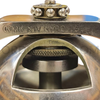
WWII U.S. Navy Mark XIV Torpedo Gyroscope No. 135
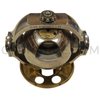
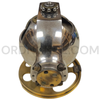
This WWII-era U.S. Navy torpedo gyroscope carries the marking "MK XIV GYRO 135." Mark XIV is the Roman numeral form of Mark 14. Its numbered assembly, circle-K stamp, and marked bearings give collectors several useful identification points. Torpedo gyroscopes were precision instruments that helped underwater weapons hold their course. This example brings that often-hidden part of naval engineering into view for a military collection, museum exhibit, or study of early guidance systems.
Identification and Features
The assembly inscription and bearing codes give collectors several points for identifying and comparing this instrument. The recorded markings are listed below.
- Item: U.S. Navy torpedo gyroscope, identified as WWII-era.
- Main marking: "MK XIV GYRO 135."
- Identifying number: No. 135.
- Additional stamp: Letter "K" inside a circle beside the main marking.
- Top and bottom bearing markings: "NORMA E-8-6."
- Side bearing markings: "79392-G-6."
- Collecting interest: Naval ordnance, torpedo steering, and precision mechanical instruments.
Function and Contents
A torpedo gyroscope supplied a steady reference for steering. Its spinning wheel resisted changes in direction, while pivoting rings, called gimbals, allowed the torpedo body to move around that reference. If the torpedo drifted off course, the gyro and its control mechanism caused the steering system to make a correction. In the Mark 14 torpedo system, the gyroscope worked with a steering engine and rudders in the rear section. Separate equipment controlled running depth. This listing covers the gyroscope assembly.
Product History
Gyroscopic steering grew from decades of work to make self-propelled torpedoes run straight. An early American example was the Howell torpedo of the 1890s, whose heavy flywheel both powered the weapon and helped stabilize its direction. Later Whitehead torpedoes used a separate gyroscope for course control. By World War II, naval gyros had become specialized instruments with carefully fitted bearings and moving rings. Their importance is reflected in the Navy's October 1942 publication, U.S. Navy Torpedo Gyroscopes Non-Tumble Type, Ordnance Pamphlet 627(A). No. 135 belongs to this broader history of mechanical guidance, although its supplied markings do not establish a manufacture date.
Documented Applications
U.S. Navy records distinguish a gyroscope's model number from the model number of the complete torpedo. The 1945 manual Torpedoes Mark 14 and 23 Types lists a Mk 12-3 gyroscope for the Mark 14-3A and Mark 23 torpedoes covered by its specifications. The inscription "MK XIV GYRO" identifies this component but does not, by itself, confirm installation in a Mark 14 torpedo. These markings do not establish the exact torpedo model or modification originally fitted with No. 135. The Mark 14 history below gives related WWII Navy context.
Bearing Markings and Precision Engineering
The bearing inscriptions are useful details for comparing this instrument with period drawings and other surviving gyros. Naval engineering literature discussed Norma bearings before World War II and stressed the need for precise bearings in gyroscopic equipment. Low friction and accurate support helped a gyro maintain its reference direction. A bearing maker's name, however, does not identify the maker of the complete assembly. The exact meanings of "E-8-6" and "79392-G-6" remain unverified. The circle-K stamp is also recorded as an identifying feature; its presence alone does not establish a manufacturer or inspection authority.
Equipment History
The Mark 14 torpedo was developed at the Naval Torpedo Station in Newport, Rhode Island, during the early 1930s to replace the older Mark 10. It was part of a design effort that also produced the aircraft-launched Mark 13 and destroyer-launched Mark 15. These weapons shared several technologies, including steam-turbine propulsion and related control systems. Limited funds led to heavy use of recoverable exercise torpedoes during testing. Those trials did not fully reproduce combat conditions, helping explain why serious problems remained hidden until wartime service.
Weapon-System Background
The Mark 14 was a 21-inch submarine-launched torpedo intended to attack surface ships. Its propulsion system used compressed air, fuel, and water to power turbines that drove the propellers. Two speed settings gave a choice between about 46 knots over 4,500 yards and 31.5 knots over 9,000 yards. The submarine’s fire-control system calculated an aiming angle before launch. Gyroscopic steering then maintained the selected course. The related Mark 23 kept the high-speed setting and removed the low-speed option. These weapons show how steering instruments, propulsion machinery, depth controls, and warheads worked together within one underwater system.
History of Use
The Mark 14 was a major weapon of American submarine patrols against Japanese ships during World War II. Its early record was troubled by deep running, premature magnetic explosions, and contact exploders that failed on impact. Fleet tests and reports forced a series of corrections during 1942 and 1943. More dependable torpedoes then strengthened the submarine campaign against enemy shipping. About 13,000 Mark 14 torpedoes were built during the war. Postwar modifications adapted surviving weapons to electrical fire-control systems, and Mark 14 Mod 5 torpedoes remained in service into the 1970s. This is the weapon family's service history; no specific submarine, patrol, or combat use is documented for gyroscope No. 135.
Condition
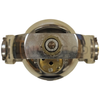
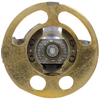
This gyroscope is offered as a historic naval collectible for display and study. The assembly and bearing stamps are important identification details. Please check the pictures for the general condition of the item.
Ideal For
The marked assembly suits collections and exhibits that explain the mechanical technology behind naval weapons. Its strongest display value lies in the connection between a small precision instrument and the larger challenge of controlling a torpedo underwater.
- U.S. Navy and WWII militaria collections.
- Torpedo and naval ordnance displays.
- Museum exhibits about mechanical guidance and steering.
- Study collections of historic gyroscopes and bearing-marked instruments.
Approx length 5", Approx width 4", Approx height 4", Approx weight 4.3lbs.
Pictures are stock images of our inventory. Unless otherwise noted, you will not be receiving the exact item shown in the pictures. The pictures are representative of the item’s general condition. The item you receive might be slightly better, or worse, condition than was shown in the pictures.
Please visit our page about order lead times here: Order Lead Times.