




Description
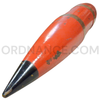
U.S. 155mm M7B1 Howitzer Drill Projectile
This U.S. 155mm M7B1 howitzer drill projectile was designed for artillery crews to practice handling and loading ammunition. Offered inert for collection and display, it represents the training equipment used alongside American 155mm guns and howitzers. Weighs 95 pounds and has free shipping to anywhere in the contiguous United States!
Training Design and Construction
The M7B1 reproduced the general shape, weight and balance of service ammunition, giving crews a realistic load for repeated drills. Its design uses a steel body with bronze bands that simulate the bearing surfaces and rotating band of a service projectile. A spring-loaded internal plunger was designed to help release the projectile after practice loading so it could be removed through the breech and reused.
Development from the M7
The M7B1 is a variation of the M7 dummy projectile, with a malleable-iron nose cap replacing the M7’s bronze cap. Army manuals restricted the M7 to gun cannons, while the M7B1 was also authorized for howitzers. Picatinny Arsenal included the M7B1 in its 1961 Complete Round Charts, and Army ammunition manuals continued to document the design into the 1990s. Its role remained ammunition handling and loading practice throughout this period.
Documented Howitzer Applications
The Army’s listed cannon applications connect the M7B1 with the M1/M114 towed-howitzer family, the M198 and several M109 self-propelled howitzer variants. These include the M198’s M199 cannon, the M185 cannon used in the M109A3/A4, and the M284 cannon used in the M109A5/A6. This range of applications made the design useful for training crews on both towed and self-propelled artillery.
History of the Associated Howitzers
The towed M1 entered production in 1941 and was later redesignated M114. It supplied supporting artillery fire during World War II, Korea and Vietnam. The M198 began replacing it in the late 1970s after development aimed at greater range and mobility. The self-propelled M109 followed a separate development path through the experimental T196 and T196E1, reaching standardization in 1963 to provide mobile artillery support for armored formations. Later M109 variants introduced improved cannons and other changes while retaining the need for realistic ammunition-handling drills.
Condition
All ordnance is inert. Please check the pictures for the general condition of the item.
Ideal For
The M7B1 suits collections and exhibits explaining how artillery crews trained with full-size ammunition before live firing.
- U.S. 155mm drill and dummy ammunition collections.
- Static displays alongside restored American howitzers.
- Museum exhibits on artillery crew training.
Approx length 28", Approx width 6", Approx height 6", Approx weight 95lbs.
Please visit our page about order lead times here: Order Lead Times.