






Description
WWII British No. 68 A.T. Mark IV Anti-Tank Rifle Grenade – G.T.L., 1943
Item Overview
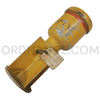
This is a World War II British No. 68 A.T. Mark IV anti-tank rifle grenade dated 1943. Its raised designation uses “IIII,” a period marking for Mark IV. The No. 68 was a direct-fire shaped-charge grenade launched from a rifle-mounted cup discharger. It was not designed to be thrown by hand. This excellent example contains its original paint and markings, as well as its internal parts. This was the first tactical use of a shaped-charge in a weapon system! Only 1 available, so you will be receiving the exact unit in the photos.
Identification and Features
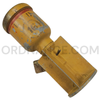
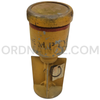
The raised markings on the tail identify the model, mark, maker code, and year. British manufacturer-code references associate G.T.L. with Gestetner Ltd. of London. The grenade retains its buff or yellow service finish, a red painted band, and fragments of black body stenciling. Wartime instructions described the service grenade as buff with red and green bands, but no green band remains visible on the photographed example.
- Raised designation: No. 68 A.T. IIII
- Model: No. 68 anti-tank rifle grenade
- Variant: Mark IV, marked “IIII”
- Maker code: G.T.L.
- Date marking: 43 for 1943
- Four-fin stabilizing tail
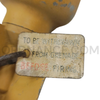
- Safety split pin and attached instruction tag
- Threaded front closure collar and removable disc
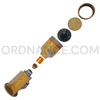
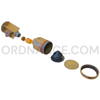
- Two threaded brass components shown in the disassembly photographs
- Original buff or yellow paint with a surviving red band
Function and Construction
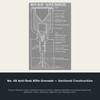
Wartime manuals describe the No. 68 as having a metal-alloy body closed by a disc and screw-on cap. A metal liner formed the shaped-charge cavity inside the body. The tail contained a central sleeve, striker, creep spring, shear wire, and safety pin, while four external fins kept the grenade pointed forward in flight. Impact drove the striker into the detonating system and directed the explosive force toward the armored target. This example has been rendered completely inert.
Documented Rifle and Discharger Applications
The No. 68 was fired from a 2.5-inch cup discharger mounted on a military rifle. British training manuals document the No. 1 Mk I discharger on the Rifle No. 1, or SMLE, and the No. 2 Mk I discharger on the Rifle No. 1, Rifle No. 3 or Pattern 1914, and the .30-caliber Pattern 1917 rifle. Later references also list the No. 3 Mk I discharger for the Rifle No. 4. A special rifle-grenade sight was issued to help the operator aim the No. 68 at short range.
No. 68 Mark IV History
The No. 68 series was developed during the 1940 invasion emergency to give British infantry a portable anti-tank weapon. It was covered by a dedicated War Office training supplement in 1941 and by the expanded grenade manual issued in 1942. Several marks were produced as the design changed during the war. The “IIII” marking identifies this example as a Mark IV, while the “43” marking dates its manufacture to 1943.
Lee-Enfield and Cup-Discharger History
The No. 68 continued the British use of rifle-mounted cup dischargers that began during World War I. Many SMLE rifles assigned to grenade launching were marked “EY” and fitted or reinforced for the heavy recoil of discharger use. The 2.5-inch cup held the grenade ahead of the rifle muzzle, and a special Ballistite cartridge supplied the launching force. Wartime instructions called for the rifle to be supported because recoil was considerable.
British Infantry Anti-Tank Weapon Background
Britain began World War II with the Boys anti-tank rifle, anti-tank guns, and several emergency grenade designs. The No. 68 added a shaped-charge weapon that could be carried and launched by infantry at close range. Increasing tank armor limited its usefulness as the war continued. The PIAT entered British service in 1943 and gave infantry units a more powerful purpose-built anti-tank weapon.
History of Use
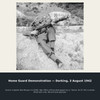
The British Army and Home Guard used the No. 68 during World War II. British training material gave an effective range of about 50 to 75 yards and taught soldiers to engage the thinner side or rear armor of a vehicle when possible. An official War Office photograph taken at Dorking on August 3, 1942, shows a Home Guard member demonstrating an EY rifle fitted with a No. 68 anti-tank grenade. National Army Museum records date No. 68 use from 1940 through 1945.
Condition
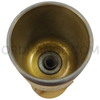
The photographed example retains original buff or yellow paint with substantial flaking, scratches, scuffs, grime, and exposed gray metal. The red band remains visible, while most black body stenciling is incomplete and cannot be read reliably. The four fins remain intact with finish loss and edge wear. The safety split pin and attached metal tag are present, and the tag remains readable with “TO BE WITHDRAWN FROM GRENADE BEFORE FIRING.” The stock photographs show the threaded front collar removed with its closure disc and two brass threaded components. The white drill grenade visible in comparison photographs is not included. All ordnance is inert.
Ideal For
The photographed markings and surviving original finish make this suitable for displays focused on British rifle grenades and wartime infantry equipment.
- World War II British ordnance collections
- No. 68 rifle-grenade displays
- Lee-Enfield and EY rifle exhibits
- British Home Guard collections
- Early shaped-charge weapon displays
- 1943-dated military artifacts
Approx length 6.5", Approx width 2.5", Approx height 2.5", Approx weight 1.5lbs.
Pictures are stock images of our inventory. Unless otherwise noted, you will not be receiving the exact item shown in the pictures. The pictures are representative of the item’s general condition. The item you receive might be slightly better, or worse, condition than was shown in the pictures.
Please visit our page about order lead times here: Order Lead Times.