




Description
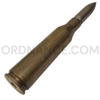
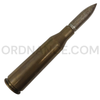
.60cal U.S. Experimental Cartridge
Item Overview
This inert U.S. .60-caliber experimental cartridge belongs to an ammunition family developed for antitank research and aircraft armament. Its history connects wartime heavy-machine-gun development with postwar revolver and rotary aircraft-gun programs.
Identification and Features
The .60-caliber designation identifies the projectile caliber within this American experimental ammunition family.
- Caliber: .60
- Country: United States
- Item type: Experimental cartridge
- Development applications: Antitank research and aircraft guns
- Status: Inert
Function
The original ammunition was developed to launch a large projectile at high velocity. Aircraft-gun research examined its ballistic performance alongside the feeding, extraction, and mechanical demands placed on automatic weapons.
Documented Applications
The .60-caliber ammunition family supported the wartime T17-series aircraft machine guns. Postwar applications included the T130 revolver gun and General Electric’s T45 multibarrel rotary gun. These were separate development programs using ammunition from the broader .60-caliber family.
Product History
The Army began developing a .60-caliber antitank cartridge in 1939. During World War II, attention shifted toward aircraft machine guns intended to offer greater performance than existing .50-caliber armament. Ammunition development continued as engineers explored several different gun mechanisms.
Equipment History
The T17 program began in 1942 using the German MG 151/20 automatic cannon as its starting point. Colt carried out the initial American conversion work. In January 1943, General Motors’ Frigidaire division undertook pilot-model development of the T17E1 and studied changes for production.
Weapon-System Background
Postwar designers explored both revolver and rotary mechanisms to increase aircraft-gun firing rates. The T130 used a revolving chamber drum with a single barrel, while General Electric’s T45 used multiple rotating barrels driven by external power. The T45 belonged to the early Vulcan development program.
Ammunition Lineage
The .60-caliber case family became the parent of the .50/.60 experimental cartridge, which used a case necked down for a .50-caliber projectile. A separate 20mm branch, known as .60/20, contributed to the development of M50-series ammunition used by the M39 and M61 aircraft cannons. These connections describe the family’s development history rather than compatibility of this .60-caliber cartridge with those later 20mm weapons.
History of Use
T17 pilot weapons underwent firing trials at Aberdeen Proving Ground during World War II. Further .60-caliber testing continued through postwar aircraft-gun programs as designers sought higher velocity, reliable automatic operation, and increased firing rates for the jet-aircraft era.
Condition
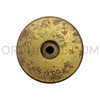
This cartridge is inert. Please check the pictures for the general condition of the item.
Ideal For
This cartridge suits collections and exhibits tracing American experimental ammunition and the development of modern aircraft guns.
- U.S. experimental ammunition collections
- T17 aircraft machine-gun research
- T130 revolver-gun studies
- Early Vulcan and T45 development exhibits
- Aircraft-cannon ammunition lineage displays
Approx length 6.5", Approx width 1.5", Approx height 1.5", Approx weight .6lbs.
Pictures are stock images of our inventory. Unless otherwise noted, you will not be receiving the exact item shown in the pictures. The pictures are representative of the item’s general condition. The item you receive might be slightly better, or worse, condition than was shown in the pictures.
Please visit our page about order lead times here: Order Lead Times.