




Description
.50cal U.S. .50/.60 Experimental Round
Item Overview
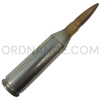
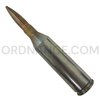
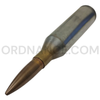
This inert U.S. cartridge is identified as a probable .50/.60 experimental round. The design came from World War II research into higher-velocity ammunition for aircraft machine guns.
Identification and Features
The supplied FA ★ 44 headstamp identifies a Frankford Arsenal case made in 1944. Frankford Arsenal was located in Philadelphia, Pennsylvania. The star matches markings found on documented examples of this experimental cartridge.
- Projectile caliber: .50
- Cartridge family: .50/.60
- Case design: Larger .60-caliber case necked down for a .50-caliber projectile
- Case-production date: 1944
- Status: Inert
Function
The larger case provided greater propellant capacity than the standard .50 Browning cartridge. By combining that capacity with a smaller .50-caliber projectile, designers sought higher velocity for aircraft armament.
Documented Applications
The .50/.60 ammunition family appeared in testing with a modified T17E3 aircraft machine gun. It also appeared in the original ammunition requirement for General Electric’s early Project Vulcan design study.
Product History
Frankford Arsenal began this development in February 1944. Experimental work included the T51 armor-piercing-incendiary cartridge and the later T75. These designations identify documented program loadings rather than establish the exact loading of this example.
Equipment History
The T17 aircraft machine-gun program began in 1942 as an American adaptation of the German MG 151/20 automatic cannon. Colt undertook the initial conversion work, and General Motors’ Frigidaire division began pilot-model development in 1943. Later T17 variants provided platforms for further ammunition trials.
Weapon-System Background
In June 1946, General Electric received a contract for a preliminary study of an externally powered, multibarrel aircraft gun. Its original requirements specified .60/.50 ammunition before changing to .60 caliber. This early work formed part of Project Vulcan, which pursued higher firing rates for use against faster aircraft.
History of Use
T75 ammunition underwent testing in a modified T17E3 machine gun in 1945. Trials examined projectile performance and stability, including problems with bullets tipping in flight. The cartridge’s documented role was experimental development and proving-ground testing.
Condition
This cartridge is inert. Please check the pictures for the general condition of the item.
Ideal For
This cartridge suits collections and educational displays covering American experimental ammunition and aircraft-armament development.
- U.S. experimental cartridge collections
- Frankford Arsenal ammunition studies
- World War II aircraft-armament exhibits
- T17 and early Project Vulcan research
Approx length 6.5", Approx width 1.5", Approx height 1.5", Approx weight .6lbs.
Pictures are stock images of our inventory. Unless otherwise noted, you will not be receiving the exact item shown in the pictures. The pictures are representative of the item’s general condition. The item you receive might be slightly better, or worse, condition than was shown in the pictures.
Please visit our page about order lead times here: Order Lead Times.