












Description
Bausch & Lomb U.S. Army Wide-Angle Vertical Multiplex Stereoplotter Projector Set of Three with Fitted Case, MIL-P-10562
This U.S. Army Corps of Engineers Multiplex stereoplotter projector set was precision photogrammetric equipment used to create topographic maps from overlapping aerial photographs.
The formal military nomenclature was Projector, Stereoplotter, Wide-Angle, Vertical, Multiplex Mapping Equipment—Set of Three Projectors in a Case with Accessories. The equipment was manufactured by Bausch & Lomb Optical Co. of Rochester, New York, and was covered by military specification MIL-P-10562.
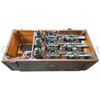
The fitted chest corresponds to Case No. 7 shown in the Army's WWII TM 5-244, Multiplex Mapping Equipment. The three principal projectors and their lamp housings appear to be present. This is not a complete operating Multiplex installation; additional equipment was required outside the case.
Historical Significance
Photogrammetry allowed military mapmakers to turn aerial photographs into accurate three-dimensional information about the ground.
The U.S. Army began developing its own Multiplex equipment before World War II. By 1939, an American version of the Multiplex system had been developed, with Bausch & Lomb playing an important role in improving the optics, projection system, and lighting. Army development records place the first group of Bausch & Lomb wide-angle projectors in military hands before the United States entered World War II.
The system became important to the Corps of Engineers, Army Map Service, and Army topographic units. During WWII, these organizations faced an enormous need for maps of Europe, North Africa, the Pacific, and other areas where current detailed mapping was limited or unavailable.
Aerial reconnaissance aircraft could photograph the terrain, but photographs alone did not provide all the elevation information needed for a topographic map. The Multiplex allowed trained operators to turn pairs of overlapping aerial photographs into a measurable three-dimensional model.
The technology remained useful well after WWII. Army manuals from the 1960s still covered Bausch & Lomb Multiplex stereoplotter frames, showing that this basic mapping system continued into the early Cold War.
What This Item Is and Does
A Multiplex projector was not an ordinary slide or movie projector.
It was a precision optical instrument designed to project a small photographic transparency, called a diapositive, made from an aerial photograph.
Two photographs of the same terrain were taken from slightly different positions as an aircraft moved along its flight path. Reduced transparencies from the overlapping photographs were placed in neighboring projectors.
One image was projected through a red filter, while the other was projected through a blue-green filter.
The operator wore matching colored spectacles. Each eye then received a different projected image. The brain combined the two views, causing the terrain to appear as a miniature three-dimensional optical model.
Mountains appeared raised, valleys appeared lower, and the operator could see the shape of the terrain instead of working from a flat photograph.
How Maps Were Made with the Multiplex
Once the projected photographs were correctly aligned, the operator used an adjustable tracing table beneath the stereo model.
The table incorporated an illuminated reference point commonly called a floating point or floating mark. By raising or lowering the table until this point appeared to touch the surface of the three-dimensional terrain model, the operator could determine elevation.
As the tracing table moved across the model, the operator could plot:
- Contour lines
- Roads
- Rivers and streams
- Shorelines
- Ridges and valleys
- Buildings
- Transportation routes
- Other terrain and cultural features
This allowed aerial photography to be converted into practical military topographic maps with both horizontal position and elevation information.
Case No. 7 and Original Equipment
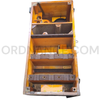
The fitted chest matches Case No. 7 documented in the 1943 War Department manual TM 5-244, Multiplex Mapping Equipment.
As originally equipped, this case was intended to carry a group of specialized Multiplex components that included:
- Three wide-angle stereoplotter projectors
- Projector lamp housings
- Red and blue-green filters
- Colored viewing spectacles
- Tracing-table equipment
- Electrical cords
- Adjustment and maintenance tools
- Spare parts and accessories
The Complete Multiplex Installation
This chest was only one part of a complete working stereoplotter installation.
To operate the projectors as intended, the Army also used equipment outside the carrying case, including:
- Multiplex mounting bar or stereoplotter frame
- Projector mounting and adjustment hardware
- Electrical transformer and controls
- Forced-air cooling equipment
- Tracing-table support equipment
- Workspace for the projected stereo model
Later Army documentation identifies a Bausch & Lomb Model 53-90-90 Multiplex double stereoplotter frame, FSN 6675-641-3521, showing the continued military use of this type of projection system during the 1960s.
Those external components are not included with this listing unless specifically shown or stated.
Identification and Markings
The surviving markings provide strong identification.
Visible markings include:
- BAUSCH & LOMB OPT. CO.
- ROCHESTER U.S.A.
- C.E. U.S. ARMY
- A.M.S. 61
- 6675
- Additional individual equipment numbers
C.E. U.S. ARMY identifies the equipment with the Corps of Engineers, U.S. Army, the branch historically responsible for much of the Army's surveying, mapmaking, and topographic work.
The A.M.S. 61 tag is consistent with Army Map Service property identification. The exact meaning of “61” has not been independently confirmed and may represent a local property or equipment number.
The 6675 marking corresponds with Federal Supply Class 6675, which covers drafting, surveying, and mapping instruments.
Key Features
- Formal nomenclature: Projector, Stereoplotter, Wide-Angle, Vertical, Multiplex Mapping Equipment
- Configuration: Set of three projectors in fitted case with accessories
- Manufacturer: Bausch & Lomb Optical Co.
- Manufacturer location: Rochester, New York, U.S.A.
- Service: U.S. Army
- Branch association: Corps of Engineers
- Army Map Service marking: A.M.S. 61
- Federal Supply Class: 6675
- Military specification: MIL-P-10562
- WWII manual reference: TM 5-244, Multiplex Mapping Equipment
- Manual date: June 30, 1943
- Fitted chest configuration: Case No. 7
- Type: Wide-angle vertical stereoplotter projector
- Primary purpose: Photogrammetric topographic mapping
- Source material: Overlapping aerial photographs
- Viewing method: Red / blue-green stereoscopic projection
- Produces an optical three-dimensional terrain model
- Used with an adjustable tracing table and floating reference point
- Three principal projector units appear present
- Lamp housings appear present
- Exact manufacture date: Not confirmed
- Period: WWII design with continued early Cold War use
Why This Item Matters
Military maps were essential for planning movements, artillery operations, engineering projects, airfields, supply routes, and combat operations.
The Multiplex helped Army mapmakers produce those maps from aerial reconnaissance at a scale and speed that would have been difficult using ground survey alone.
This set is particularly interesting because the technology is easy to see and understand. Three precision projectors worked together to turn flat photographs into a measurable three-dimensional landscape decades before digital terrain models, satellites, GPS, or computer mapping.
It also represents the close relationship between aerial reconnaissance, military cartography, precision optics, and the Army Corps of Engineers during World War II.
Surviving Bausch & Lomb military Multiplex equipment is an unusual artifact from the history of both military intelligence and American mapmaking.
About This Item
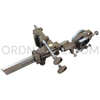
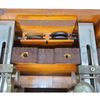
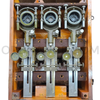
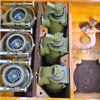
The photographed projectors retain their olive-drab finish and original Bausch & Lomb markings. One visible projector is marked BAUSCH & LOMB OPT. CO. ROCHESTER U.S.A., along with A.M.S. 61 and a 6675-series military identification marking.
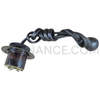
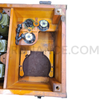
The fitted military chest and the three principal projector/lamp assemblies appear to be present. Smaller accessories, filters, spectacles, tools, cords, tracing-table components, spare parts, or other items originally packed in Case No. 7 may be missing.
The separate stereoplotter mounting frame/bar, transformer and control equipment, forced-air cooling blower, and other equipment needed to create a complete operational Multiplex installation are not included unless specifically shown.
The exact manufacturing date of this particular set has not been established. The design is WWII-era, but these systems remained useful after the war and this example may have continued in Army service into the early Cold War.
Optical condition, electrical operation, alignment, calibration, lamp operation, and completeness have not been verified. This equipment is best suited for collection, restoration, technical study, or museum display unless professionally inspected.
Ideal For
- WWII U.S. Army Corps of Engineers collections
- Army Map Service collections
- Military cartography displays
- WWII aerial-reconnaissance exhibits
- Photogrammetry collections
- Bausch & Lomb military optics collections
- Surveying and mapping museums
- Historical aerial-photography collections
- Military intelligence exhibits
- Topographic engineering displays
- Early Cold War mapping collections
- History of technology collections
Approx length 40", Approx width 19", Approx height 17", Approx weight 142.5 lbs.
Pictures are stock images of our inventory. Unless otherwise noted, you will not be receiving the exact item shown in the pictures. The pictures are representative of the item's general condition. The item you receive might be slightly better, or worse, condition than was shown in the pictures.
Please visit our page about order lead times here: Order Lead Times