






Description
Vietnam-Era U.S. M7A3 CS Riot-Control Hand Grenade with M201A1 Fuze — Original Paint and Markings (Inert)
Item Overview
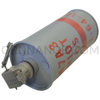
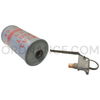
This inert U.S. M7A3 CS riot-control hand grenade retains its original paint and markings and is fitted with an M201A1 fuze. Its military finish, model identification, and readable lot code make it a useful study piece for Vietnam-era ordnance collections and historical displays.
Identification and Features
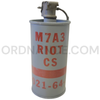
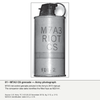
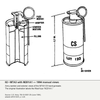
The markings identify the grenade model, original purpose, original agent, fuze model, and manufacturing batch. Each has a different meaning within the military identification system.
- “M7A3” identifies the M7 grenade family and its A3 modified model.
- “RIOT” identifies the grenade’s original riot-control role.
- “CS” is the military code for the original tear-gas agent carried by this model.
- Gray paint with red lettering and a single red band follows the period color code for a nonpersistent riot-control filling.
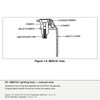
- “FUZE M201A1” identifies the standard delay-igniting fuze fitted to the grenade.
- “LOT-2021-64-1024” identifies the production batch and contains coded manufacturer, line, and date information.
Production Lot and Date Interpretation
Applying the documented 1960–1967 grenade-numbering format, “202” identifies Unidynamics and the following “1” identifies the production line. In the middle group, “6” indicates fiscal year 1966 and “4” indicates January/February. The final “1024” is the lot sequence. The fiscal year then ran from July through June; January and February fell within the calendar year named by the fiscal-year code. This interpretation points to likely manufacture or assembly in January–February 1966. The “64” combines year and month codes rather than simply meaning 1964.
Function
In its original service configuration, the M201A1 fuze ignited a composition that dispersed CS agent through openings in the grenade body. The M7A3 used a thin sheet-metal canister with four emission openings at the top and one at the bottom. Pressure-sensitive tape originally covered these ports to protect the filling from moisture.
Documented End-Item Application
The end item is the complete M7A3 hand grenade, combining its agent-dispersing canister with the M201A1 ignition fuze. TM 43-0001-29, pages 2-45–2-46, documents this combination under NSN 1330-00-965-0802 and DODAC 1330-G963. The NSN identifies the standard supply item. The ammunition code combines supply class 1330, for grenades, with the G963 ammunition-type code. These are catalog references for the complete military munition.
Product History
The M7A3 continued the development of the CS-filled M7A2. Both used a similar cylindrical metal body, but the M7A2 carried its CS agent in gelatin capsules while the M7A3 used pelletized CS. The form and amount of the original filling were the main differences between the two models. The Army’s 1966 TM 9-1330-200 documented both versions. The M7A3 also appeared in the 1969 FM 23-30 and remained cataloged in the Army’s 1994 grenade data sheets, tracing the design through several decades of technical documentation.
Parent-Equipment History
The M7A3 belonged to a wider family of U.S. special-purpose grenades that shared the M201A1 ignition fuze. By 1966, Army manuals specified this fuze for M7-series riot-control grenades, AN-M8 white-smoke grenades, M18 colored-smoke grenades, and AN-M14 incendiary grenades. One ignition-fuze model served several different munition types. This history explains why collectors must read the fuze designation together with the body markings to identify the complete grenade correctly.
Weapon-System Background
The M7 family has roots in World War II American chemical-munition production. Army history records 243,020 M7 CN tear-gas grenades manufactured at Huntsville Arsenal between December 1943 and April 1944. The original M7 had emission openings along its sides. The M7A1 used four top openings and one bottom opening, a body layout carried forward into the CS-filled M7A2 and M7A3. The M7A3 therefore belongs to a design family that evolved from wartime CN canister grenades into later CS models.
History of Use
The M7A3 saw documented service during the Vietnam War. The Army’s after-action report for Operation Malheur records M7A3 use in Vietnam in 1967, including operations involving the 1st Battalion, 327th Infantry, and 2nd Battalion, 502nd Infantry. Army publications also described riot-control and chemical-defense training roles. These records establish the model’s wartime service history and give context to this example’s likely early-1966 production lot.
Condition
The original gray paint, red markings, and production lot identification remain on this example. Sealing-tape residue is visible around the bottom emission port, and the fuze opening shows evidence of burning. Please check the pictures for the general condition of the item.
Ideal For
This grenade suits Vietnam-era militaria collections, U.S. hand-grenade displays, and museum exhibits about military chemical-service equipment. Its original markings allow direct comparison with period identification guides. Paired with technical manuals, it can illustrate the development of the M7 family, shared fuze designs, and older ammunition lot-numbering practices.
Approx length 6", Approx width 3", Approx height 3", Approx weight 0.6lbs.
Please visit our page about order lead times here: Order Lead Times.