




Description
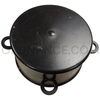
U.S. Navy Time of Flight Clock Mark I Mod. 1 – Ford Instrument Co., 1938
Item Overview
This portable U.S. Navy Bureau of Ordnance clock helped naval gunnery personnel follow the predicted flight time of a fired projectile. It signaled when the shell was nearing its expected impact or water-entry time, allowing a spotter to watch the correct fall of shot and report aiming corrections. The identification plate dates this example to 1938. Only 1 available, so you will be receiving the exact unit shown in the photos! For a video overview of this item, check out the YouTube video under the VIDEOS tab next to the DESCRIPTION tab.
Identification and Features
The clock and fitted storage case retain clear identification, control, and wiring information. Visible features include the central timing scale, mechanical controls, electrical connection, winding handle, and attachment rings.
- Official designation: Time of Flight Clock Mark I Mod. 1
- Serial number: 426
- Date marking: 6.9.38
- Manufacturer: Ford Instrument Co., Inc., Long Island City, New York
- Government authority: U.S. Navy Bureau of Ordnance
- Plate-listed weight: 8 lb.
- Controls: STOP/RUN selector and ALARM/SILENT control
- Dial: Central 0–20 timing scale
- External equipment: Folding winding handle, three-contact connector, and four attachment rings
- Case: Fitted gray-painted wooden case with handle, green felt lining, latch, and internal wiring plate
- Ford drawing number: 10194
- Bureau of Ordnance drawing number: 192326
- Electrical supply: 20 volts DC
Function and Operation
A time-of-flight setting was based on the predicted travel time of the projectile. Once started, the clock counted toward the expected fall-of-shot time. The case wiring diagram identifies a contact, relay, plug connector, and horn or buzzer powered by a 20-volt DC supply. This circuit provided an audible warning so the observer could focus on the target area just before the shell was expected to arrive.
Documented Naval Application
The Mark I time-of-flight clock was developed for U.S. Navy gunfire observation and fire-control work. It was used by gunnery personnel to time shell splashes during naval firing. The earlier Mark I design formed part of the operating equipment associated with Ford’s Range Keeper Mark I. The plate on this Mark I Mod. 1 does not assign serial 426 to a particular ship, gun caliber, director, or rangekeeper installation.
Product History
Hannibal Ford developed an early time-of-flight clock while building mechanical fire-control equipment for the U.S. Navy. His original clock patent was filed in 1918 and granted in 1920. Ford Instrument continued improving the idea, including a signaling system designed to warn observers before impact and help them follow closely spaced shots. This Mark I Mod. 1 was produced in 1938, shortly before World War II.
Range Keeper History
Ford Instrument’s Range Keeper Mark I entered U.S. Navy use during World War I and was the company’s first major product. A rangekeeper used mechanical calculations to follow the changing range and bearing between a ship and its target. The time-of-flight clock supported the observation stage after firing; it was not the complete rangekeeper or a stand-alone firing computer.
Naval Gunfire-Control Background
Long-range naval gunfire required several connected jobs. Rangefinders and directors gathered target information, rangekeepers predicted target movement, gun crews fired using calculated orders, and spotters watched where the shells landed. The time-of-flight clock connected the calculated shell travel time with the moment the observer needed to watch for a splash or hit.
History of Use
During training or combat firing, many seconds could pass between a gun firing and the projectile reaching the target area. More than one salvo might be in the air at the same time. A timed alarm helped the observer identify the expected arrival of each shot, judge whether it landed short, over, left, or right, and pass corrections back through the ship’s fire-control team. No documented service record for this individual clock is included.
Condition
The clock and fitted wooden case are included as shown. The black-painted instrument has scattered paint loss, scratches, exposed edges, and age-related surface patina. The case shows finish wear, scratches, small chips, aged hardware, and wear to the green interior lining. The identification plate and lid-mounted wiring diagram remain legible. The controls, winding handle, electrical connector, and side rings are present as pictured.
Ideal For
This dated Bureau of Ordnance instrument is well suited to collections and displays focused on naval gunnery, mechanical fire control, or early analog computing.
- U.S. Navy fire-control collections
- Pre-World War II and World War II naval displays
- Ford Instrument Company collections
- Mechanical and analog computing exhibits
- Naval ordnance museums and educational displays
Approx length 8", Approx width 8", Approx height 5", Approx weight 8lbs.
Pictures are stock images of our inventory. Unless otherwise noted, you will not be receiving the exact item shown in the pictures. The pictures are representative of the item’s general condition. The item you receive might be slightly better, or worse, condition than was shown in the pictures.
Please visit our page about order lead times here: Order Lead Times.
