









Description
WWII U.S. M140A1 81mm Mortar Ammunition Container – Milcor Steel Co.
Item Overview
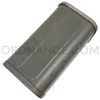
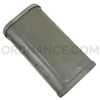
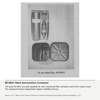
This U.S. military M140A1 steel ammunition container was designed to carry four complete 81mm mortar rounds. Its factory stamps identify Milcor Steel Co., while its military stencils record the original capacity and ammunition shipping category. The maker, location, and date markings add a direct connection to American wartime manufacturing.
Identification and Features
The markings distinguish the container model from its intended contents.
- M140A1: The container model, identified by the Office of the Chief of Ordnance as the “81-mm Metal Box, M140A1.”
- MILCOR STEEL CO: The manufacturer’s name, stamped into the bottom.
- MIL WIS 44: Interpreted as Milwaukee, Wisconsin, with a 1944 production date. This reading agrees with Milcor’s documented Milwaukee location and the container’s wartime design.
- 4 C/R SHELL: Four complete rounds of shell ammunition. “C/R” means complete round, identifying assembled ammunition rather than loose projectile bodies.
- AM FOR CANNON WITH EXP PROJ: Abbreviated wording for “Ammunition for cannon with explosive projectiles.” “AM” means ammunition, “EXP” means explosive, and “PROJ” means projectiles. This identifies the cargo category without naming a particular shell model.
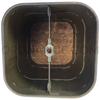
- Construction: Rounded-square steel body with reinforcing ribs, a gasketed lid, and a central closure screw engaging the threaded bridge inside.
Function
The M140A1 protected ammunition during shipment, storage, and field handling. Each of its four mortar rounds was first enclosed in an individual fiber packing tube, then placed inside the steel outer container. The fiber tubes separated and protected the rounds, while the ribbed steel body resisted handling damage. Tightening the lid’s central screw pressed the cover against its gasket to help exclude moisture.
Documented End-Item Application
The relevant World War II weapon was the U.S. 81mm M1 mortar. Period Army records identify the M43A1 light high-explosive shell as one of its combat rounds. This shell produced blast and fragments for use against personnel and light targets, including machine-gun positions. It illustrates the explosive-projectile ammunition described by the shipping stencil. The supplied markings do not establish the exact shell model originally packed in this particular container.
Product History
The M140A1 belonged to the wartime metal-container program developed to supplement wood and fiber packing where extreme moisture and rough handling caused problems. An April 1945 Office of the Chief of Ordnance exhibit illustrates this exact container model. Its maker began in 1902 as the Milwaukee Corrugating Company, adopted the Milcor Steel Company name in 1930, and became an Inland Steel subsidiary in 1936. In January 1948, the business became Inland Steel Products Company. The stamped Milcor name therefore preserves the company identity used during World War II.
Parent-Equipment History
The M1 mortar’s development came from the Army’s adoption of French Brandt mortar designs during the 1930s. The Army’s official procurement history records that its 81mm mortars were first manufactured at Watervliet Arsenal. Commercial manufacturers joined production as American rearmament expanded in 1939 and 1940. The M140A1 supported the ammunition supply needs of this growing mortar inventory.
Weapon-System Background
The Army’s 1944 ammunition manual described the 81mm M1 as a refinement of the older 3-inch trench mortar. It was a smoothbore, muzzle-loading weapon intended for high-angle fire in support of infantry and cavalry. Its fin-stabilized ammunition included light and heavy high-explosive shells, along with smoke and training rounds. The term “cannon” on this container belongs to the transport classification: contemporary regulations expressly included ammunition fired from mortars within that category.
History of Use
By June 1945, Army manual TM 9-1900 described metal containers as standard packing for 60mm and 81mm mortar ammunition, while reserving them for shipment to certain theaters. Wooden boxes and cloverleaf bundles continued to be used alongside them. Physical evidence also places the M140A1 in the Pacific theater: the 2014 Peleliu archaeological survey recorded examples on the battlefield and identified their four-round packing arrangement. These findings document the container type’s place in wartime ammunition supply.
Condition
This example retains its lid, internal closure bridge, and bottom cushioning. The individual fiber packing tubes are absent. The M140A1 model marking is embossed near the bottom, with the suffix faint beneath the paint. Please check the pictures for the general condition of the item.
Ideal For
This container adds a clearly marked ammunition-packing component to a World War II collection or educational display. Its maker stamps and cargo stencils help explain how mortar ammunition moved through the wartime supply system.
- U.S. World War II equipment and ammunition-container collections.
- 81mm M1 mortar and infantry-support displays.
- Military logistics and American wartime manufacturing exhibits.
Approx length 16", Approx width 9", Approx height 9", Approx weight 18lbs.
Please visit our page about order lead times here: Order Lead Times.