













Description
U.S. Army AN/VLQ-6 "Hardhat" Missile Countermeasure Device – Serial No. 0881
Item Overview
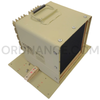
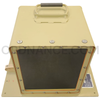
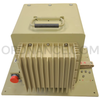
This U.S. Army AN/VLQ-6 "Hardhat" missile countermeasure device, serial number 0881, is a collectible piece of armored vehicle protection equipment. Its data plate preserves the military designation, stock number, contract number, and part number. Linked to the Gulf War procurement period, Hardhat illustrates the growing role of electronics in protecting combat vehicles during the late Cold War and the years that followed.
Identification and Data Plate
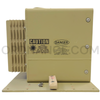
The identification plate reads as follows, giving collectors specific details for cataloging and historical research:
- COUNTERMEASURES SET AN/VLQ-6
- SERIAL. NO. 0881
- NSN: 5865-01-334-3538
- DSGN ACT: 80063
- CONTRACT: DAAB07-91-C-J513
- MFG CAGE: 12705
- PART NO. A3171144
- U.S. ARMY
Function
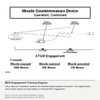
Hardhat was an electro-optical jammer designed to improve a vehicle's chances of surviving an anti-tank guided missile, or ATGM, attack. It belongs to the soft-kill class of active protection systems, which interfere with guidance rather than physically intercepting a missile. Its infrared output was intended to confuse compatible missile tracking equipment and cause guidance errors. A key threat was SACLOS, meaning semi-automatic command to line of sight, in which the launcher tracks the missile while the gunner keeps the sight on the target. The device's purpose was to make the missile miss; it did not guarantee missile destruction.
Installation and System Features
The AN/VLQ-6 was designed for roof or turret mounting and used the host vehicle's 28-volt DC electrical supply. It could work in an open-loop, stand-alone mode or be integrated with other warning and self-protection equipment. Standard installations placed the display and controls near the vehicle commander. The system was marketed against multiple compatible ATGM threats launched from the ground or aircraft, with effectiveness dependent on the missile's guidance method.
Coverage and Optional Configurations
Published specifications give a 40-degree horizontal field of view, rather than full coverage around the vehicle. One or more jammers could cover selected protection zones across the forward arc. Options included an external armor plate, a gimbal mount that could turn toward a warning sensor's cue, and a pop-up optical assembly. These describe available system configurations and should not be read as a list of accessories included with serial number 0881.
Product History
Loral Electro-Optical Systems developed the AN/VLQ-6 as a private venture. A November 1997 program report records a $25.3 million Army award in January 1991 for 1,377 devices under contract DAAB07-91-C-J513. That number matches this item's plate, connecting it to the documented procurement program. The report estimated that total orders eventually reached about 2,600 units and that contracted production was completed in 1991. Its later contractor listing names Lockheed Martin, reflecting the corporate changes that followed Loral's original development work.
Documented Applications
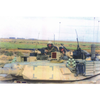
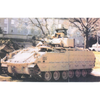
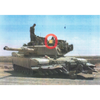
The M2 and M3 Bradley And M1A1 Abrams families are documented applications for the AN/VLQ-6. Its design also allowed installation on other tracked and wheeled military vehicles. Missile countermeasure devices became part of the broader Bradley Operation Desert Storm upgrade effort. The ODS name refers to improvements shaped by lessons from the Gulf War; it does not establish that every upgraded vehicle or jammer was present during the 1991 fighting.
Equipment History
Vehicle missile jammers grew from efforts to apply aircraft warning and countermeasure ideas to ground combat. Adding thicker armor increased weight, so designers also sought ways to interfere with threats before impact. During the 1990s, the Vehicle Integrated Defense System program explored combining sensors, warnings, and countermeasures. A Naval Postgraduate School study specifically identified Hardhat as a planned addition to that integrated suite. This development placed the device within a larger shift toward layered vehicle protection.
Weapon-System Background
The Bradley and Abrams served different roles in U.S. armored forces. The M2 Bradley carried infantry, while the related M3 supported cavalry scouting. The M1A1 Abrams was a main battle tank built around heavy armor, mobility, and a powerful main gun. Guided anti-tank missiles threatened these vehicles despite their different roles. Equipment such as Hardhat added an electronic layer of protection alongside armor, smoke, and crew tactics. These platforms helped drive demand for compact, vehicle-mounted missile countermeasures.
Comparable Systems
The Soviet and Russian Shtora-1 program pursued a related soft-kill approach through electro-optical countermeasures. U.S. Army reporting discussed Shtora installations or demonstrations on T-80, T-90, and Ukrainian T-84 tanks. These systems show the international effort to reduce the danger from guided missiles. Their similar purpose does not establish that Hardhat was copied from Shtora or shared its service-life figures.
History of Use
Desert Shield and Desert Storm accelerated U.S. demand for vehicle missile countermeasures. The 1997 program account reports that limited numbers of developmental VLQ-6 units reached the Gulf for field trials during the ground campaign. That limited fielding differs from the much larger procurement estimate. The wider MCD story continued into the Iraq War, when Marine Corps M1A1 Abrams tanks carried electro-optical missile countermeasure equipment during Operation Iraqi Freedom in 2003. Accounts of this period must distinguish Loral's VLQ-6 from the separate Sanders VLQ-8A. The supplied plate does not establish a combat deployment for serial number 0881.
Condition
Please check the pictures for the general condition of the item. The historical specifications describe the system's design and do not establish this device's present operating condition.
Ideal For
This AN/VLQ-6 Hardhat suits collections that explore military electronics, armored vehicle development, and the history of battlefield survivability. Its detailed identification plate gives researchers a useful starting point, while the device adds context to displays of the equipment carried beyond a vehicle's main armament.
- U.S. Army and Marine Corps armor history collections
- Gulf War and Iraq War-era equipment displays
- Military electronic countermeasure exhibits
- Bradley and Abrams vehicle research collections
Approx length 14", Approx width 18", Approx height 12", Approx weight 25.4lbs.
Please visit our page about order lead times here: Order Lead Times.