




Description
USAF Type Y-4 Bombsight Optical Dome for Boeing B-47B/B-47E Stratojet – K-4A Bombing-Navigation System
Item Overview
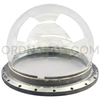
This circa-1950s USAF optical dome was used with the Type Y-4 horizontal periscopic bombsight installed in the nose of the Boeing B-47B and B-47E Stratojet. It formed the sight’s exterior optical window and belonged to the aircraft’s larger K-4A bombing-navigation system. This is the detachable optical-dome assembly only, not a complete Y-4 bombsight, radar radome, or aircraft astrodome.
Identification and Features
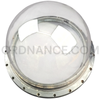
USAF Technical Order 11B41-5-5-1, dated July 15, 1957, identifies this component as the “OPTICAL DOME.” Its formed-glass profile, stepped retaining rings, seals, and drilled mounting flange match the documented dome fitted to complete Y-4 bombsight assemblies.
- Official component name: Optical Dome
- Associated sight: Type Y-4 Horizontal Periscopic Bombsight
- Bombing-navigation system: K-4A
- Documented aircraft: Boeing B-47B and B-47E Stratojet
- Specified dome diameter: 9.8 inches
- Specified projection: 9-7/32 inches ahead of the sealing-ring flange
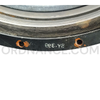
- Visible white flange stencil: SY 399
- Construction: Formed optical glass with stepped retaining rings, seals, and drilled flange
- No separate dome part number, FSN, or NSN was located in the reviewed documentation
- Numbers 1280-537-3285, SYA-34003, and MIL-S-5802 identify a complete Block I Y-4 sight, not this detachable dome
Optical Dome Function
The dome served as the aerodynamic exterior window for the nose-mounted Y-4 bombsight. It protected the sight’s optical path while allowing the bombardier-navigator to view the ground and target area through the periscopic system. The Y-4 used a geared lens mount designed to hold its line of sight on the target during aircraft maneuvers. The dome did not calculate a bombing solution and was not used as a handheld optic.
Documented B-47 Application
Air Force technical documentation and the National Museum of the United States Air Force identify the Y-4 as equipment used in the noses of B-47B and B-47E Stratojets. The dome projected through the aircraft’s lower nose area and provided the external optical opening required by the sight. Its dimensions, flange arrangement, and retaining-ring design are consistent with that installation.
Optical Dome Production History
Perkin-Elmer developed the Y-4 design, but production involved several American optical and electronics companies. Documented complete sights include IBM-manufactured examples, while an American Optical engineering account describes that company fusing Y-4 domes under an IBM contract. General Mills later mass-produced Y-4 sights. These records describe the wider production program but do not establish the manufacturer of this particular dome.
Type Y-4 Bombsight History
The Y-4 was a horizontal periscopic bombsight developed for fast jet bombers during the early Cold War. It allowed the B-47’s bombardier-navigator to conduct visual bombing operations from inside the pressurized nose compartment. Its stabilized and geared optical system helped maintain a target view while the aircraft maneuvered during an approach.
K-4A Bombing-Navigation System
The Y-4 was the optical bombsight within the B-47’s K-4A bombing-navigation system. The complete K-4A installation combined the Y-4 sight, A-1A bombing-navigation computer, and AN/APS-23 radar. Together, these components supported both visual and radar-assisted bomb delivery. The optical dome was one external part of this larger integrated system.
B-47 Stratojet Weapons-System Background
The Boeing B-47 Stratojet first flew in 1947 and introduced swept wings, pod-mounted jet engines, and high-speed performance to the United States strategic bomber force. More than 2,000 B-47 aircraft were built in several versions. The design became a major part of Strategic Air Command and helped shape later American jet bombers, including the larger B-52 Stratofortress.
History of Use
B-47 bombers served as an important part of the United States’ Cold War nuclear deterrent. They operated from American bases, deployed to forward locations, and maintained strategic alert duties during the 1950s and early 1960s. The bomber force did not conduct wartime bombing missions, although reconnaissance versions performed hazardous intelligence flights near and over communist territory. Most B-47 bombers left service by 1965, with specialized Stratojet variants continuing for several more years.
Condition
The available photographs document the optical glass assembly, stepped retaining hardware, seals, drilled flange, and white “SY 399” stencil. No separate dome identification plate, part number, FSN, NSN, or confirmed manufacturer marking has been documented. No condition grade, optical-clarity rating, or test status has been supplied, so buyers should review the listing photographs for the condition of the available assembly. The complete Y-4 bombsight and aircraft installation are not included.
Ideal For
This specialized Cold War aircraft component is suited to collections and displays focused on American strategic aviation, optical fire-control equipment, and the development of airborne bombing-navigation systems.
- Boeing B-47 restoration and research projects
- USAF and Strategic Air Command collections
- Y-4 or K-4A system displays
- Cold War aviation museums and educational exhibits
- Collectors of military optics and aircraft instrumentation
Approx length 11", Approx width 11", Approx height 9", Approx weight 8lbs.
Pictures are stock images of our inventory. Unless otherwise noted, you will not be receiving the exact item shown in the pictures. The pictures are representative of the item’s general condition. The item you receive might be slightly better, or worse, condition than was shown in the pictures.
Please visit our page about order lead times here: Order Lead Times.