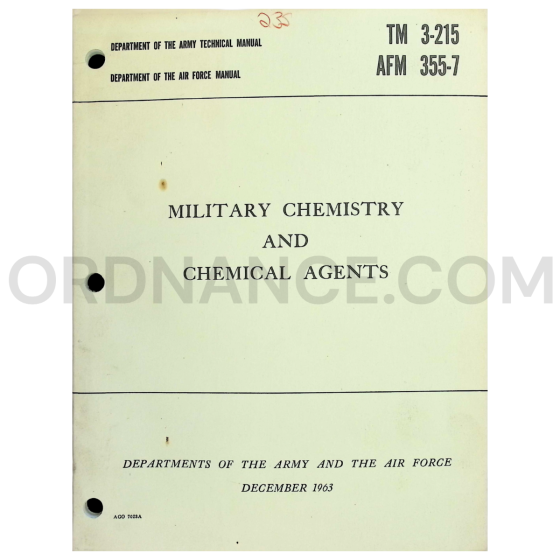
This TM 3-215 Military Chemistry and Chemical Agents Technical Manual Dated: 1963 is an original Cold War-era U.S. Army reference covering the basic chemistry, characteristics, and military context of chemical agents and related defensive subjects. For collectors of military manuals, CBRN history, Cold War training literature, and U.S. Army technical publications, it is an important reference document from a period when chemical defense remained a serious part of military planning and instruction.
Issued during the early 1960s, this manual reflects the Army’s effort to provide a structured technical foundation for personnel dealing with military chemistry, chemical agents, protective considerations, and related training subjects. Manuals of this type were intended to support instruction and technical understanding across the broader field of chemical warfare defense and military chemical operations. In historical terms, it belongs to the same era as other Army publications produced for the Chemical Corps and for units expected to operate in environments where chemical threats were considered a real possibility.
What TM 3-215 Covers
As indicated by its title, TM 3-215 focuses on the broad subject of military chemistry and chemical agents. In general terms, manuals in this category were intended to explain the scientific and military background of chemical agents, their classification, their effects in a doctrinal context, and the principles of protection, identification, and chemical defense. That makes this manual especially useful as a historical and doctrinal reference rather than just a collectible booklet.
For collectors and researchers, it is the kind of publication that helps document how the U.S. Army taught and organized its understanding of chemical warfare subjects during the Cold War.
Historical Significance
The year 1963 places this manual squarely in the Cold War period, when the possibility of chemical warfare remained part of serious U.S. military planning. During that era, training literature on chemical agents, decontamination, protective procedures, and military chemistry was an important part of Army technical education. Manuals like TM 3-215 provide insight into the language, doctrine, and instructional priorities of that time.
That makes this item appealing not only to collectors of technical manuals, but also to historians interested in:
- Cold War military doctrine
- U.S. Army Chemical Corps history
- CBRN / chemical defense training
- military science and technical education
- government-issued survival, defense, and technical manuals
About This Manual
This listing is for TM 3-215 Military Chemistry and Chemical Agents Technical Manual Dated: 1963. It is a useful fit for:
- Cold War U.S. Army manual collections
- Chemical Corps and CBRN history displays
- military library and archive collections
- museum exhibits on chemical defense and training
- researchers interested in period technical doctrine
Because manuals were working documents, surviving examples are often valued both for their content and for what they reveal about the real training environment of the time.
Why This Manual Matters
Many military manuals focus on weapons, vehicles, or field equipment. TM 3-215 is different because it documents a technical and doctrinal subject that was central to Cold War defense planning but is often underrepresented in collections. It adds depth to any archive or display centered on Army training, military science, or chemical defense history.
For collectors, it is a strong standalone manual. For researchers, it offers period language and structure that help place later CBRN doctrine in context. For museums, it is the kind of supporting document that helps tell the broader story behind Cold War preparedness and military technical education.
Ideal For
This manual is a strong fit for:
- U.S. Army technical manual collections
- Cold War and Chemical Corps displays
- CBRN and civil defense history collections
- museum and archival reference libraries
- collectors of dated military paperwork and technical publications
Approx length 10", Approx width 8", Approx height .25", Approx weight .2lbs.
Pictures are stock images of our TM 3-215 Military Chemistry and Chemical Agents Technical Manual Dated: 1963. Unless otherwise noted, you will not be receiving the exact item shown in the pictures. The pictures are representative of the item's general condition. The item you receive might be slightly better, or worse, condition than was shown in the pictures.
Please visit our page about order lead times here: Order Lead Times