


Description
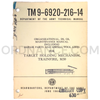
TM 9-6920-216-14 M30 Trainfire Target Holding Mechanism Technical Manual
Add a Vietnam War era range-equipment reference to your collection with TM 9-6920-216-14, dated June 1966. This U.S. Army technical manual covers the M30 Trainfire Target Holding Mechanism. This copy includes the April 1968 Change 1 update integrated throughout the manual.
Identification and Features
This publication documents the equipment behind controlled target presentations during military marksmanship training.
- Manual number: TM 9-6920-216-14
- Equipment covered: M30 Trainfire Target Holding Mechanism
- Base publication date: June 1966
- Included update: Change 1, April 1968, integrated throughout
Function and Contents
This is an operator, organizational, and field maintenance reference for the M30. Its scope covers the use and upkeep of the target holding mechanism, serving the personnel who operated and maintained range equipment. It offers collectors a technical companion to the Army's broader rifle marksmanship publications.
Product History
The separate M30 title belongs to an earlier stage of the Army's target-equipment documentation. By May 1972, TM 9-6920-203-14 covered the M30 alongside the M30A1, M31A1, and a target-detection aiming device. That later publication shows how the Army grouped related training equipment within a broader maintenance reference.
Documented Applications
The M30 supported outdoor rifle training with silhouette targets. Military specifications described its use with both automatic and semiautomatic small-arms fire in .30 caliber and 7.62mm. This connects the manual with the target equipment used on military rifle training and qualification ranges.
Equipment History
The M30 belonged to a family of powered target mechanisms with remote controls. A 1973 military specification covering the M30 and M30A1 described dual targets, a hit-recording device, and automatic target lowering when struck by small-arms fire. These features gave range personnel a way to present targets and record hits through electrical and mechanical equipment.
Weapon-System Background
Trainfire became the Army's official rifle marksmanship course in 1957. It used pop-up silhouette targets to create a more realistic training setting. After M14 rifles began reaching infantry units in 1960, the course was adapted for the new rifle. Target mechanisms such as the M30 supported this wider move toward controlled, timed target presentations.
History of Use
The M30 remained documented in Army rifle training literature during the 1970s. FM 23-8, covering M14 and M14A1 rifles and rifle marksmanship, identified the mechanism in its automatic-rifle range illustrations. Large-area and linear target layouts show how these devices formed part of organized range courses after this manual's base publication and update.
Ideal For
This manual suits collections focused on military training technology and the support equipment behind rifle ranges. Its integrated update also makes it useful for comparing Army publications and tracing how equipment references were revised.
- Trainfire and military range-equipment collectors
- Vietnam War era technical manual collections
- M14 rifle training historians
- Military museum research libraries
- Historical range-equipment displays
Approx length 8", Approx width 10", Approx height .25", Approx weight .5lbs.
Pictures are stock images of our inventory. Unless otherwise noted, you will not be receiving the exact item shown in the pictures. The pictures are representative of the item’s general condition. The item you receive might be slightly better, or worse, condition than was shown in the pictures.
Please visit our page about order lead times here: Order Lead Times.