


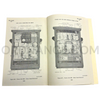

Description
Technical Manual (TM 9-669) for M8 Series Gun Data Computers October 1944
Own a rare piece of World War II fire-control computer history with this Technical Manual TM 9-669 for the M8 Series Gun Data Computers. Dated October 1944, this War Department manual covers one of the most technically impressive artillery fire-control systems of the wartime era.
The M8 Series Gun Data Computer was part of the leap from manual plotting boards to powered, precision fire-control equipment. Reference listings identify TM 9-669 as Gun Data Computers M8 Series, published by the War Department in October 1944, with a listed length of 293 pages.
Historical Significance
The M8 gun data computer sits at the crossroads of artillery, electronics, coast defense, and early military computing. It was not a simple calculator. It was a specialized fire-control computer built to process target and ballistic data for artillery use.
A 1946 Coast Artillery Journal article described the earlier Gun Data Computer T12 as designed and built by Bell Telephone Laboratories, tested in 1943, and standardized as the Gun Data Computer M8. The same source noted that the M8 was intended for intermediate-caliber batteries and was considered more accurate than earlier fire-control methods.
That gives this manual major collector appeal. It documents the moment when U.S. artillery fire control moved from manual plotting into advanced mechanical and electrical computing.
The M8 Series Gun Data Computers
The M8 Series belonged to the world of large artillery fire-control systems. These computers helped convert target data into firing data for guns, using connected components such as triangle solvers, position generators, predictors, power units, and line-balancing equipment.
A wartime ordnance catalog describes M8-series gun data computers as using electrical computing elements and receiving input from fire-control instruments such as azimuth instruments, depression position finders, and radio range-finding equipment. It also lists variants and components such as M8C, M8F, M8N, and M8P, along with triangle solvers, position generators, and predictors.
For collectors, this is the “cool factor.” This manual is tied to the machinery behind wartime artillery accuracy. It belongs to the same technical world as directors, range finders, radar, plotting rooms, observation stations, and coast artillery batteries.
What This Manual Covers
As a technical manual for the M8 Series Gun Data Computers, TM 9-669 would have served as an official War Department reference for the identification, operation, care, and support of this fire-control computer family.
This manual is especially relevant for:
- M8 Series Gun Data Computer documentation
- World War II fire-control computer research
- Coast Artillery and seacoast defense collections
- early military computing history
- Bell Telephone Laboratories-related fire-control development
- artillery predictor and position-generator reference
- radar-era fire-control equipment displays
- museum and archival reference libraries
- collectors of rare War Department technical manuals
Key Features
- Technical Manual TM 9-669
- Covers Gun Data Computers M8 Series
- Dated October 1944
- War Department technical manual
- Reference listings identify it as 293 pages
- Strong World War II fire-control subject
- Connected to early military computing and artillery prediction systems
- Relevant to Coast Artillery, radar-era gunnery, and large-caliber gun batteries
- Excellent reference for serious ordnance and technical manual collections
- Desirable companion piece for collections focused on fire-control instruments, directors, range finders, and plotting equipment
Why This Collectible Stands Out
Most World War II manuals cover rifles, tanks, trucks, artillery pieces, or basic maintenance tools. This one covers something much more unusual: a wartime gun data computer.
That makes it a standout manual for collectors who appreciate the technical side of military history. The M8 Series represents the hidden machinery behind accurate artillery fire. It helped turn observation data into usable firing data before modern digital systems existed.
For collectors, this manual has strong crossover appeal. It fits ordnance collections, coast artillery collections, early computer history displays, electronics collections, and World War II fire-control exhibits.
About This Manual
This listing is for Technical Manual TM 9-669 for M8 Series Gun Data Computers, dated October 1944.
This listing is for the manual only unless otherwise stated. No gun data computer, predictor, triangle solver, position generator, power unit, fire-control instrument, radar equipment, cable system, tools, parts, or additional accessories are included unless specifically shown or noted.
Ideal For
This manual is a strong fit for:
- World War II U.S. Army technical manual collections
- M8 Series Gun Data Computer reference libraries
- Coast Artillery and seacoast defense displays
- early military computer collections
- radar-era fire-control equipment exhibits
- U.S. Army Ordnance Department publication collections
- museum and archival reference collections
- serious artillery, electronics, and fire-control historians
Approx length 9", Approx width 6", Approx height .75", Approx weight 1lbs.
Pictures are stock images of our inventory. Unless otherwise noted, you will not be receiving the exact item shown in the pictures. The pictures are representative of the item's general condition. The item you receive might be slightly better, or worse, condition than was shown in the pictures.
Please visit our page about order lead times here: Order Lead Times