


Description
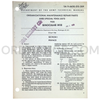
M18 Binocular Parts Manual TM 9-6650-215-20P
This U.S. Army technical manual covers maintenance parts support for the M18 infrared binocular. TM 9-6650-215-20P offers a period reference for collectors studying early electronic night vision and the supply system behind military optical equipment.
Identification and Features
Key publication details include:
- Manual number: TM 9-6650-215-20P
- Publication date: April 20, 1964
- Publisher: Headquarters, Department of the Army
- Subject: M18 infrared binocular
- Publication type: Organizational maintenance repair parts and special tools list
- Equipment FSN: 6650-863-5657
Function and Contents
The 20P publication served as the parts reference for organizational maintenance, meaning work performed by mechanics at the unit. It identified replacement parts available through Army supply channels and served as the authority for ordering them. This gives the manual value for researching how the M18 was supported in service.
Publication History
This title formed part of the Army's 1964 M18 manual series. It supported the companion operator and maintenance manual with replacement-parts information. A new edition issued on March 17, 1971, later superseded the April 1964 publication, placing this issue within the binocular's early support history.
Documented Applications
The Army's M18 operator manual names the 105mm-gun M60 tank series as the binocular's initial application. It assigns organizational maintenance to the turret mechanic. That documented link makes this parts manual relevant to research on armored-unit equipment and maintenance.
Equipment Function
The M18 allowed night observation with infrared illumination from a source such as a xenon searchlight. Two image-converter tubes turned invisible infrared light into a picture the user could see. Its battery-powered system combined separate optical channels in a handheld binocular.
Equipment History
The M18 represents an early stage in portable electronic night-viewing equipment. Its design brought powered infrared observation into a self-contained instrument. Military specification MIL-B-46334C, issued on November 15, 1972, continued to define the M18 as a handheld infrared binocular for night observation and limited lighting conditions.
Weapon-System Background
The M60 tank combined a 105mm gun and diesel engine with features developed from the M48. Combat units in Europe first received the M60 in December 1960. The improved M60A1 entered production in 1962, and the M60 family became a mainstay of American armored forces through much of the Cold War.
History of Use
Army revisions to the M18 operating manual continued into 1974, documenting support beyond the binocular's early manual series. Tank viewing equipment later changed as passive night sights became available. An Army history records that the 1977 M60A1 improvement package added passive sights and removed the vehicle's infrared system, marking a shift from the technology this manual supported.
Ideal For
This publication adds a parts-support reference to collections and research libraries focused on military optics and armored vehicles.
- Collectors of U.S. Army technical manuals
- Researchers studying infrared night-vision equipment
- M18 binocular and M60 tank enthusiasts
- Museums documenting Cold War maintenance and supply
Approx length 8", Approx width 10", Approx height .1", Approx weight .15lbs.
Pictures are stock images of our inventory. Unless otherwise noted, you will not be receiving the exact item shown in the pictures. The pictures are representative of the item’s general condition. The item you receive might be slightly better, or worse, condition than was shown in the pictures.
Please visit our page about order lead times here: Order Lead Times.