




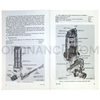

Description
TM 9-6173 M25 / T42 Periscope Sight Technical Manual
This U.S. Army technical manual focuses on the M25 / T42 Periscope Sight associated with the early M48 Patton tank family. Its specialized subject makes it a useful companion to vehicle manuals and period references on military optics.
Identification and Features
The publication identifies the sight by both its standardized M25 name and its earlier T42 designation.
- Manual number: TM 9-6173
- Publication date: November 1957
- Subject: M25 / T42 Periscope Sight
- Associated vehicles: 90mm M48 / M48A1 Patton tanks
- Equipment role: Commander's cupola machine-gun sight
Periscope Sight Function
The M25 provided an aiming view for the commander's .50-caliber M2HB machine gun. From inside the armored cupola, the commander could sight the weapon through a periscope projecting above the roof. The optical system used 1.27-power magnification.
Publication History
The November 1957 issue dates from the early Cold War, when the Army was fielding and supporting its M48-series armored force. Its M25 (T42) nomenclature also appears in the Army's later TM 9-500 equipment catalog, allowing researchers to cross-reference the sight in other period records.
Documented Applications
Army equipment lists associate the M25 / T42 with the M48, M48A1, and M48C. The detailed sight entry specifically describes the M48A1 commander's cupola installation, where the M104 periscope mount supported the sight through the roof. This connects the publication to early Patton cupola and machine-gun equipment.
Equipment History
Standardized from T42 to M25, the sight used a fixed eyepiece and an internal prism linked to the machine gun's elevation. Its sealed, nitrogen-filled optical system helped resist moisture. Army records identify the sight under FSN 1240-344-4675.
Weapon-System Background
The M48 Patton family emerged in the early 1950s as the United States strengthened its armored forces during the Cold War. Named for General George S. Patton Jr., the tank combined a 90mm main gun with a four-man crew. The M48A1 added the enclosed M1 commander's cupola, which brought the .50-caliber machine-gun installation into a more protected arrangement.
History of Use
M48A1 tanks served with U.S. armored forces in Europe during a tense period of Cold War rivalry. In October 1961, tanks from Company F, 40th Armor, stood guard at Checkpoint Charlie in Berlin as American and Soviet armor confronted each other across the crossing. This deployment provides historical context for the early Patton equipment documented by the manual.
Ideal For
This publication is well suited to detailed study of early M48-family equipment and the development of protected machine-gun sights. It also provides a focused subject for museum libraries and collections devoted to military optical instruments.
- U.S. Army technical-manual collectors
- M48 and M48A1 Patton restoration researchers
- Military optics and fire-control historians
- Museums building Cold War armor reference collections
Approx length 6", Approx width 9", Approx height .2", Approx weight .4lbs.
Pictures are stock images of our inventory. Unless otherwise noted, you will not be receiving the exact item shown in the pictures. The pictures are representative of the item’s general condition. The item you receive might be slightly better, or worse, condition than was shown in the pictures.
Please visit our page about order lead times here: Order Lead Times.