



Description
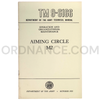
TM 9-6166 M2 Aiming Circle Technical Manual
This U.S. Army technical manual documents the M2 Aiming Circle, a portable optical instrument used for military survey and gun alignment. It offers a period reference to the equipment and support practices behind Cold War fire control.
Identification and Features
This publication combines the basic manual with its later update in an original reprint edition.
- Manual number: TM 9-6166
- Equipment covered: M2 Aiming Circle
- Basic publication date: October 1955
- Format: Original Reprint
- Included update: Change 1, dated June 7, 1963
Manual Scope and Contents
TM 9-6166 covers operation and organizational maintenance. This means using the instrument and providing care at the unit level. Army tank gunnery publications also identify this manual as a reference for aiming-circle inspection and maintenance procedures, giving it value for research into both field use and equipment upkeep.
M2 Aiming Circle Function
The M2 measures horizontal and vertical angles from a selected reference direction. Its telescope, magnetic compass, angle scales, and leveling assembly work together to provide precise readings. These measurements helped crews establish direction and relate separate positions to a common reference.
Publication History
The basic manual was issued during the early Cold War, when optical instruments played a central role in military survey. Change 1 formed part of the Army's process of updating technical guidance. Its inclusion makes this reprint useful for studying the publication beyond its first issue. The later 1981 M2 and M2A2 operator's manual also references TM 9-6166, showing its place in the equipment's publication history.
Documented Applications
Army publications record M2 use in artillery survey and tank gunnery. Its applications included establishing directional references, measuring angles, and aligning tank guns for indirect fire. These uses show why an aiming circle could support several types of units.
- Field artillery survey and directional control
- Horizontal and vertical angle measurement
- Parallel alignment of tank guns for indirect fire
Equipment History
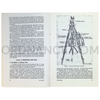
The M2 combined a four-power, fixed-focus telescope with mechanical controls and a magnetic compass in a tripod-mounted instrument. It brought several survey functions into one portable assembly. Later Army documentation covered the M2 alongside the M2A2, an improved version with greater upward telescope travel. This continued coverage reflects the lasting role of optical instruments in military survey work.
Weapon-System Background
The M2 supported the fire-control work of artillery and armored units. For indirect fire, crews must aim weapons at targets they may not see from their firing positions. A shared directional reference helps separate guns work together. Tank gunnery doctrine also used the aiming circle to align gun tubes in parallel, regardless of the direction each tank hull faced.
History of Use
An Army survey test at Fort Sill on March 22, 1958, provides a documented example of M2 use. The June 1958 issue of Artillery Trends reported that eight M2 aiming circles served at field stations, with one also acting as a master station. The test demonstrated their role in sharing direction between separated positions during Cold War training.
Ideal For
This manual is well suited to readers studying military optics, artillery survey, and the upkeep of precision instruments. Its included Change 1 also makes it useful for researching how Army technical publications were updated.
- U.S. Army technical-manual collectors
- M2 Aiming Circle owners and restoration researchers
- Military museums and reference libraries
- Cold War artillery and fire-control historians
Approx length 6", Approx width 9", Approx height .2", Approx weight .4lbs.
Pictures are stock images of our inventory. Unless otherwise noted, you will not be receiving the exact item shown in the pictures. The pictures are representative of the item’s general condition. The item you receive might be slightly better, or worse, condition than was shown in the pictures.
Please visit our page about order lead times here: Order Lead Times.