




Description
TM 9-6163 T24E2 Ballistic Drive Technical Manual — April 1955
Explore the mechanical side of early Patton tank fire control with TM 9-6163. This April 1955 Army technical manual covers the T24E2 ballistic drive used in the 90mm M48 tank. It offers collectors a focused reference on the equipment that connected ballistic corrections with the tank's sighting system.
Identification and Features
These details identify the publication and connect its period equipment name with later Army terminology.
- Publication number: TM 9-6163
- Publication date: April 1955
- Subject: Ordnance maintenance of the T24E2 ballistic drive
- Later standard designation: M5 ballistic drive
- Parent weapon system: 90mm M48 Patton tank
Manual Scope and Contents
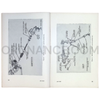
This publication focuses on the ballistic drive as a separate maintenance subject. Its illustrated material includes an overall assembly view and an exploded view of the superelevation drive, housing, and bearings. These drawings show how the major parts fit together and help researchers identify the drive's mechanical components.
Ballistic Drive Function
The T24E2 linked the ballistic computer, gun mount, gunner's periscope, and rangefinder. It transmitted mechanical corrections through the sighting system, including the allowance for superelevation. Superelevation is the extra elevation needed to account for a projectile's curved flight path. The drive helped maintain the required relationship between the gun and the optical lines of sight.
Publication History
Issued in April 1955, TM 9-6163 belongs to the Army's early Cold War ordnance maintenance literature. Its dedicated subject reflects the practice of documenting complex tank components in separate publications. Read alongside the M48 vehicle and gunnery manuals, it helps show how individual mechanisms fitted into the complete fire-control system.
Documented Applications
The later Army equipment catalog TM 9-500 identifies the drive as M5 (T24E2) and lists it for the following 90mm tank models. These entries provide documented applications for the equipment covered by this publication.
- M48 Patton
- M48A1 Patton
- M48C Patton
Equipment History
The T24E2 designation records the drive's development identity, while later Army records use the standardized M5 name. The design belonged to a generation of fire-control equipment that passed motion through shafts, gears, and connecting links. Later M48A2 and M48A2C catalog entries list the M5A1 (T24E5), showing further development within the ballistic drive family.
Weapon-System Background
The M48 Patton combined armor, mobility, and a 90mm main gun for Cold War armored combat. Its fire-control system brought together optical instruments and mechanical equipment to measure distance and apply ballistic corrections. The rangefinder, computer, sights, and drive each performed a separate task, making their connections an important part of the tank's design.
History of Use
Period Army diagrams show the T24E2 within the M48's complete sighting system, documenting its role in early Patton tank equipment. The M48 family later saw combat service in Vietnam, where its tanks supported infantry with protected firepower. Marine Corps museum records describe M48 tanks contributing to the fighting at Hue. That later service gives broader context to this manual's record of an earlier fire-control arrangement.
Ideal For
This publication suits collections centered on Patton tanks, military mechanical systems, and Army maintenance history. Its specific drive designation also makes it useful when organizing related manuals or researching the equipment behind a period tank display.
- U.S. Army technical manual collectors
- M48 Patton restoration reference libraries
- T24E2 / M5 ballistic drive researchers
- Museums interpreting Cold War tank fire-control equipment
Approx length 6", Approx width 9", Approx height .25", Approx weight .5lbs.
Pictures are stock images of our inventory. Unless otherwise noted, you will not be receiving the exact item shown in the pictures. The pictures are representative of the item’s general condition. The item you receive might be slightly better, or worse, condition than was shown in the pictures.
Please visit our page about order lead times here: Order Lead Times.