




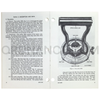

Description
TM 9-6133 M26 Fuze Setter Technical Manual — January 1955
This U.S. Army technical manual covers the M26 fuze setter, including its documented use with M500 and M501 fuzes. Dated January 1955, TM 9-6133 offers a focused reference for collectors and researchers studying artillery support equipment. It records a small but important part of the mechanical fire-control tools used during the early Cold War.
Identification and Features
The publication is identified by its Army technical manual number and its specific equipment subject. These details help match it with related ammunition and artillery references.
- Manual number: TM 9-6133
- Publication date: January 1955
- Subject: M26 Fuze Setter
- Publication category: Ordnance Maintenance
- Documented fuze applications: M500 and M501
Manual Contents and Purpose
The Army's publication index lists this title as an Ordnance Maintenance manual devoted to the M26. Its focus is the technical care of the setter as a piece of mechanical equipment. This makes it useful alongside broader ammunition and gunnery publications when researching how artillery tools were maintained and supported.
Equipment Function
The M26 is a hand-operated mechanical fuze setter. Its job was to apply a selected time value to a compatible artillery fuze. This linked timing information from the fire-control process with ammunition preparation, helping crews make consistent settings.
Publication History
Issued in January 1955, TM 9-6133 belongs to the Army's early Cold War maintenance literature. Its date places it after the Korean War armistice, during a period when mechanical instruments remained central to artillery work.
Documented Applications
Army publications confirm the M26's use with the two fuze models identified for this listing. These applications connect the setter to timed artillery ammunition and give the manual a clear place in a collection of fuze and fire-control references.
- M500 fuze
- M501 fuze
Equipment History
The M26 shared its general operating approach with the M22 and M23 fuze setters. Its design included paired time scales and a built-in light to help crews read the instrument in darkness. Army maintenance literature highlighted these features, showing the attention given to clear readings and practical field use in mechanical artillery equipment.
Associated Fuze Background
The M500 and M501 belong to the mechanical time and superquick fuze category. This combines a mechanical timing function with prompt action on impact. Their place in artillery ammunition explains the need for a precise setting instrument and connects the M26 to the wider history of timed shell fire.
Weapon-System Background
One later documented weapon context is the 155mm M109 and M109A1 self-propelled howitzer. Production of the M109 began in 1963, after this manual appeared. Its tracked, armored carriage supported mobile artillery operations. The M26's appearance in the Army's 1974 manual for these howitzers illustrates how support tools could remain useful as larger weapon systems changed.
History of Use
The Army featured the M26 in the September 1957 issue of PS, its preventive maintenance magazine. Field manuals continued to document the tool into the 1970s, including its place in howitzer crew duties and equipment checks. Together, these records trace Army documentation of the M26 across nearly two decades after this manual's publication.
Ideal For
This manual adds a specialized equipment subject to an artillery reference library and complements collections of period ammunition and maintenance publications.
- Collectors of Army technical manuals and Cold War military publications
- Researchers studying M26 fuze setters and M500 or M501 fuze history
- Museums documenting artillery crews and their support equipment
- Historians studying mechanical fire-control and maintenance practices
Approx length 6", Approx width 9", Approx height .2", Approx weight .4lbs.
Pictures are stock images of our inventory. Unless otherwise noted, you will not be receiving the exact item shown in the pictures. The pictures are representative of the item’s general condition. The item you receive might be slightly better, or worse, condition than was shown in the pictures. Please check the pictures for the general condition of the item.
Please visit our page about order lead times here: Order Lead Times.