




Description
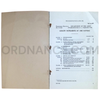
TM 9-6129 M1 and M1918A2 Azimuth Instruments Technical Manual
This September 1954 technical manual covers the M1 and M1918A2 azimuth instruments used for artillery observation and spotting. It is a focused reference for collectors, historians, and researchers studying Army optical equipment. Its subject connects older mechanical fire-control designs with the technical publications of the early Cold War.
Identification and Features
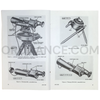
The covered instruments combined a telescope, an adjustable mount, and a tripod. Their optical and mechanical parts allowed observers to view distant objects and measure angles with precision.
- Publication number: TM 9-6129
- Publication date: September 1954
- Covered models: Azimuth Instruments M1 and M1918A2
- Equipment role: Artillery observation, angle measurement, and spotting
Equipment Function
Azimuth means horizontal direction, measured as an angle from a reference line. Both instruments used 10-power telescopes and graduated scales to make precise observations. Their mounts allowed measurement around a full circle of 6,400 mils, the Army's angular unit. A marked pattern inside the telescope helped observers measure how far a shell burst appeared from the target.
Publication History
The September 1954 edition belongs to a longer line of Army documentation for these instruments. The War Department published TM 9-1680 for the M1918 and M1918A2 in June 1942, and government records list parts support for the M1 and M1918A2 in 1943. TM 9-6129 provides a postwar reference point for comparing publications about this equipment family.
Documented Applications
A 1942 Army manual identifies the M1918A2 as an observation and spotting instrument for field artillery organizations. Its listed users included headquarters batteries and specialized observation units. The Army's 1944 equipment catalog describes the M1 in the same general spotting and observing role.
- Battalion headquarters batteries
- Regimental headquarters batteries
- Sound- and flash-ranging batteries
Equipment History
The M1918A2 was made by modifying earlier M1918 azimuth instruments for field artillery work. Changes included a grid pattern inside the telescope, a single 10-power eyepiece, and a different tripod arrangement. The similar M1 was newly manufactured. The Army's 1944 catalog makes this distinction, helping explain why two closely related instruments appear together in later technical literature.
Parent-Equipment History
The earlier M1918 azimuth instrument served Coast Artillery units in observation and spotting stations. Its documented applications included 155mm M1917 and M1918 guns and their modifications when used by the Coast Artillery Corps. That background links the instruments in this manual to the optical equipment used to support shore-based gun batteries.
Weapon-System Background
The M1 and M1918A2 formed part of the wider field artillery observation network. Guns and howitzers often fired at targets beyond the gun crews' view. Observers supplied measurements and reports that helped artillery teams locate targets and judge the effects of fire. Accurate optics, plotting equipment, and communications were essential parts of that work.
History of Use
An October 1944 Field Artillery Journal article described tests in which ground observers used M1 azimuth instruments with an observer in an aircraft. Their angle readings were plotted on an M5 flash-ranging board to help locate targets. This documented example shows how optical instruments, radios, telephones, and plotting boards worked together in wartime artillery observation.
Ideal For
This manual adds a specialized subject to a military reference collection and offers useful context for studying related artillery instruments.
- Collectors of Army technical manuals and military optics publications
- Researchers studying artillery observation and fire-control history
- Museums and archives documenting wartime and early Cold War equipment
Approx length 6", Approx width 9", Approx height .35", Approx weight .7lbs.
Pictures are stock images of our inventory. Unless otherwise noted, you will not be receiving the exact item shown in the pictures. The pictures are representative of the item’s general condition. The item you receive might be slightly better, or worse, condition than was shown in the pictures. Please check the pictures for the general condition of the item.
Please visit our page about order lead times here: Order Lead Times.