



Description
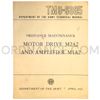
TM 9-6085 M2A2 Motor Drive and M1A2 Amplifier Technical Manual — April 1955
Technical Manual TM 9-6085 covers the M2A2 Motor Drive and M1A2 Amplifier used with the 90mm M2 and M2A1 guns. Dated April 1955, this publication focuses on equipment that linked electrical fire control data to the gun’s fuze-setting mechanism. It offers a specialized reference for collectors, museums, and researchers studying early Cold War antiaircraft artillery.
Identification and Features
The manual number, date, and exact component designations help identify this title within an Army technical reference collection.
- Publication: TM 9-6085
- Date: April 1955
- Covered equipment: M2A2 Motor Drive and M1A2 Amplifier
- Gun applications: 90mm M2 and M2A1
- Associated mechanism: M20 Combination Fuze Setter-Rammer
- Technical subject: electrical control of automatic fuze setting
Equipment Function
The M1A2 Amplifier controlled the motor in the M2A2 Motor Drive. Together, these units helped the M20 Combination Fuze Setter-Rammer follow fuze-setting data from the antiaircraft director. The motor positioned the setting mechanism to match the transmitted value. This connected the battery’s electrical calculations with the mechanical preparation of ammunition at the gun.
Publication History
The April 1955 publication date falls within the Army’s postwar effort to maintain and improve heavy antiaircraft guns. These weapons combined wartime gun designs with newer fire control equipment. A separate technical manual for the motor drive and amplifier reflects the detailed references needed to support the electrical parts of these systems.
Documented Applications
The covered equipment served the 90mm M2 and M2A1 guns. Army records also group the M2A2 Motor Drive and M1A2 Amplifier with the M12A1 Remote Control System in test instructions for use with the M33C Antiaircraft Fire Control System. This places the pair within a larger battery arrangement of radar, computing equipment, and gun-mounted controls.
Equipment History
Earlier Army maintenance references listed the M2A1 Motor Drive and M1A1 Amplifier with the M20 mechanism. By January 1953, Army documentation identified the M2A2 and M1A2 equipment in connection with the M33C system. These records show how the Army continued to adapt the 90mm gun’s supporting equipment as fire control technology developed.
Parent-Equipment History
The 90mm M2 entered service in 1943 as an improvement over the earlier M1. Its design supported both antiaircraft work and fire against ground targets, including armor. Mechanized ammunition handling helped its crew maintain a high rate of fire. The M2 and M2A1 applications covered by this manual belong to that heavy antiaircraft gun family.
Weapon-System Background
Heavy antiaircraft batteries had to predict where a moving aircraft would be when a shell arrived. Radar and computing equipment supplied aiming information and, for timed ammunition, fuze-setting data. The M33C system brought these tasks together for 90mm batteries. Reliable electrical and mechanical connections were essential to carrying those calculations through to the guns.
History of Use
The M2 gun family served in the European and Pacific theaters during World War II and later in the Korean War. Army 90mm guns remained important into the mid-1950s. A Philco field-engineering article published in March–April 1955 discussed M2A2 motor failures and M1A2 amplifier operation, providing a period record of the maintenance challenges surrounding this equipment.
Ideal For
This manual adds a focused technical subject to collections covering artillery, military electronics, and the support work behind radar-directed guns.
- Collectors of Army technical manuals
- 90mm M2 and M2A1 gun researchers
- Restoration researchers studying the M20 fuze setter-rammer
- Museums interpreting Cold War air defense equipment
- Students of early military control systems and electronics
Approx length 8", Approx width 10", Approx height .5", Approx weight 1lbs.
Pictures are stock images of our inventory. Unless otherwise noted, you will not be receiving the exact item shown in the pictures. The pictures are representative of the item’s general condition. The item you receive might be slightly better, or worse, condition than was shown in the pictures. Please check the pictures for the general condition of the item.
Please visit our page about order lead times here: Order Lead Times.