



Description
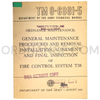
TM 9-6081-5 T38 Fire Control System Maintenance Manual – August 1954
Study the maintenance work behind radar-directed air defense with TM 9-6081-5. This August 1954 U.S. Army technical manual addresses the T38 Fire Control System associated with the 75mm Skysweeper antiaircraft gun. It offers a specialized reference for military manual collectors, equipment researchers, and historians of Cold War artillery.
Identification and Features
This ordnance maintenance publication focuses on servicing, refitting, and checking T38 fire-control equipment.
- Manual number: TM 9-6081-5
- Publication date: August 1954
- Equipment covered: T38 Fire Control System
- Publication type: U.S. Army ordnance maintenance manual
- Associated weapon: 75mm Skysweeper antiaircraft gun
Manual Contents
Topics include general maintenance procedures, removal, installation, alignment, and final inspection. Together, these subjects document the work involved in refitting fire-control equipment and checking the installation after maintenance, making the manual useful for studying the system's technical support requirements.
Publication History
The Army's publication index records an issue date of August 16, 1954. TM 9-6081-5 formed part of the broader TM 9-6081 series, whose separate publications addressed operating theory, inspection, and component repair. Its subject shows how the Army organized specialized maintenance information for an increasingly complex generation of antiaircraft equipment.
Documented Applications
Period Army operating references identify T38 as the fire-control system used with the 75mm Skysweeper, known in service as the M51. The equipment linked radar tracking, computing, and powered gun controls within the weapon installation. This gives the manual a direct connection to the maintenance of the Skysweeper's aiming and control equipment.
Equipment History
A 1953 Army article presented the Skysweeper's combination of radar, computer, and gun as a major advance in integrated artillery. Development continued during the decade, and the Army published operating instructions for an improved T38 system in December 1955. This 1954 maintenance reference belongs to that early period of fielding and refinement.
Parent-Equipment History
Developed after World War II, the M51 Skysweeper was a towed 75mm antiaircraft weapon with automatic loading and firing features. Its loader-rammer handled the ammunition-feeding work needed for rapid fire. Rock Island Arsenal manufactured loader-rammer equipment in 1955, illustrating the specialized industrial support behind the complete gun system.
Weapon-System Background
Fast postwar aircraft left gun crews little time to detect a target and establish accurate aim. The Skysweeper's radar supplied target-position information to a computer, which calculated where the gun should point to intercept the moving aircraft. Powered controls positioned the gun, bringing tracking, prediction, and gun movement into a coordinated system.
History of Use
Skysweeper battalions served in the Army's air-defense network during the 1950s. Army history records a peak deployment of eight battalions in the middle of the decade. Units guarded locations including Sault Sainte Marie and Savannah River. The expansion of Nike missile defenses reduced the Skysweeper force during the late 1950s.
Ideal For
This manual complements period Skysweeper operating references and adds maintenance documentation to a military technical library.
- Collectors of U.S. Army technical manuals
- T38 and M51 Skysweeper researchers
- Restorers studying period equipment installation and alignment
- Historians of radar-directed antiaircraft artillery
- Museums interpreting Cold War air-defense technology
Approx length 8", Approx width 10", Approx height .5", Approx weight 1lbs.
Pictures are stock images of our inventory. Unless otherwise noted, you will not be receiving the exact item shown in the pictures. The pictures are representative of the item’s general condition. The item you receive might be slightly better, or worse, condition than was shown in the pictures. Please check the pictures for the general condition of the item.
Please visit our page about order lead times here: Order Lead Times.