


Description
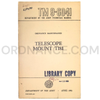
TM 9-6041 T181 Telescope Mount Technical Manual – April 1954
Explore early Cold War artillery fire control with TM 9-6041, the Army technical manual for the T181 Telescope Mount. This publication covers the mount used with T159 and T159E1 telescopes, making it a useful reference for military optics collectors and artillery researchers.
Identification and Features
These publication details help match this manual to the correct equipment and period.
- Manual number: TM 9-6041
- Publication date: April 1954
- Subject: T181 Telescope Mount
- Associated telescopes: T159 and T159E1
- Publication category: Ordnance maintenance
Function
The T181 held the direct-fire telescope securely beside the weapon. It provided the mechanical connection needed to keep the sight properly aligned with the gun. This allowed the crew to aim through the telescope at a visible target.
Publication History
An Army publications index lists TM 9-6041 as Ordnance Maintenance: Telescope Mount T181. Its April 1954 issue date places it in the early development and service period of postwar self-propelled artillery, before the M55 howitzer was standardized in 1955.
Documented Applications
Period Army manuals document this mount in the fire-control equipment of the 155mm M53 self-propelled gun and the 8-inch M55 self-propelled howitzer. These related vehicles developed from the T97 gun and T108 howitzer projects, respectively.
Equipment History
T181 was the mount’s development-era designation; later Army records identify it as the M101 Telescope Mount. The associated T159/T159E1 telescope family appears under the M99 designation. These name changes help connect early technical references with later service manuals.
M53 and M55 Vehicle History
The M53 and M55 grew from the postwar effort to improve heavy artillery mobility and crew protection. Their shared layout placed the engine at the front and the crew in an enclosed rear fighting compartment. Tracks allowed these large weapons to move between firing positions under their own power.
Weapon-System Background
The M53 carried the 155mm M46 gun, while the M55 carried the 8-inch M47 howitzer. Their fire-control equipment included separate sights for different tasks. A panoramic telescope supported indirect fire at unseen targets, while the T159-series telescope supported direct fire at visible targets.
History of Use
Army manuals from the 1950s document the M53/M55 sighting system in service. Both vehicle types later served with Marines in Vietnam. An official Marine Corps history records the replacement of M55 howitzers with the M110 during 1967, marking a shift to a newer generation of self-propelled artillery.
Ideal For
This specialized manual adds context to collections and displays focused on military optics and early Cold War artillery. Its equipment names also make it a useful companion reference when studying related telescopes and mounts.
- Collectors of Army technical manuals and military optics literature
- Researchers studying T181 and M101 telescope mounts
- Restorers researching M53 and M55 sighting equipment
- Museums building displays about postwar artillery development
Approx length 6", Approx width 9", Approx height .15", Approx weight .2lbs.
Pictures are stock images of our inventory. Unless otherwise noted, you will not be receiving the exact item shown in the pictures. The pictures are representative of the item’s general condition. The item you receive might be slightly better, or worse, condition than was shown in the pictures.
Please visit our page about order lead times here: Order Lead Times.