



Description
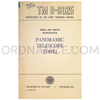
TM 9-6025 T149E1 Panoramic Telescope Technical Manual
This September 1955 technical manual covers the T149E1 Panoramic Telescope, an artillery sight documented on the 105mm M52 self-propelled howitzer. TM 9-6025 connects military optics collecting with the history of postwar U.S. Army fire-control equipment.
Identification and Features
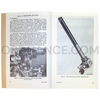
The telescope combined an optical reticle with mechanical azimuth scales to help gunners establish precise sight directions.
- Manual number: TM 9-6025
- Publication date: September 1955
- Equipment covered: T149E1 Panoramic Telescope
- Publication series: U.S. Army technical manual
Function of the Panoramic Telescope
The T149E1 helped gunners set the howitzer’s direction for indirect fire. The gunner used an external reference, such as an aiming post, and entered deflection angles on coarse and fine scales, allowing aiming when the target was out of sight.
Publication History
The September 1955 edition belongs to the Army’s early Cold War technical literature. It predates the December 1956 M52 crew manual, which also identifies the T149E1. Together, these dated references place the publication within the Army’s shift to new self-propelled artillery after the Korean War.
Documented Applications
Army field manual FM 6-77 identifies the T149E1 on the M52, paired with the T179 telescope mount. The T150E1 served as the separate direct-fire sight, establishing the panoramic telescope’s place within the vehicle’s sighting system.
Equipment History
A development report dated November 1956 identifies the telescope as M100 (T149E1). This paired name connects the earlier designation with the M100 name found in later Army records. That link is useful when comparing period manuals, marked equipment, and historical parts catalogs.
Parent-Equipment History
The Army accelerated the M52 program during the Korean War as it sought more self-propelled artillery. The vehicle was standardized in 1955. It belonged to a new group of postwar artillery vehicles that also included the M44 and M55 howitzers and the M53 gun, reflecting a wider effort to modernize mobile fire support.
Weapon-System Background
The M52 paired a 105mm howitzer with a tracked vehicle and an enclosed turret. This arrangement brought artillery firepower and crew protection into a mobile platform. During the 1950s, Army planners pressed for greater range, mobility, and wider fields of fire, setting the goals for later generations of self-propelled weapons.
History of Use
Army crew drills included level checks, aiming-post alignment, and periodic sight tests. The T149E1 also served for emergency direct aiming, a role normally handled by the T150E1. These instructions document its place in M52 training and routine service.
Ideal For
This manual offers a focused subject for a military reference collection. It is useful for connecting equipment designations with the artillery systems, sighting methods, and technical publications of the mid-1950s.
- Collectors of U.S. Army technical manuals
- Researchers studying Cold War artillery optics
- Museums documenting M52 fire-control equipment
- Collectors comparing T149E1 and M100 references
Approx length 6", Approx width 9", Approx height .35", Approx weight .7lbs.
Pictures are stock images of our inventory. Unless otherwise noted, you will not be receiving the exact item shown in the pictures. The pictures are representative of the item’s general condition. The item you receive might be slightly better, or worse, condition than was shown in the pictures.
Please visit our page about order lead times here: Order Lead Times.