



Description
TM 9-3071-1 - 60mm and 81mm Mortar Field Maintenance Manual - January 1958
Item Overview
TM 9-3071-1 is a January 1958 U.S. Army technical manual for field maintenance of 60mm and 81mm mortars and their supporting equipment. It addresses repair work beyond normal crew maintenance. This publication makes a useful reference for collectors studying the weapons, mounts, and baseplates that supported American infantry during the mid-20th century.
Identification and Features
The coverage includes two mortar calibers and several generations of mounting equipment. Note that M1 identifies both a 60mm baseplate and a separate 81mm mortar.
- Publication: TM 9-3071-1.
- Issue date: January 1958.
- 60mm mortars: M2 and M19.
- 60mm supporting equipment: M5 mortar mount and M1 mortar baseplate.
- 81mm mortars: M1 and M29.
- 81mm mounts: M4, M23A1, M23A2, and M23A3.
- Subject: Field maintenance and repair.
Function and Manual Contents
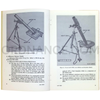
Contents include special tools, inspection, troubleshooting, disassembly, repair, and assembly. Component drawings show the major working parts. Final inspection and repair standards explain the checks used before equipment returned to service.
Publication History
The January 1958 edition replaced the field maintenance portion of TM 9-1260, dated March 14, 1952. Its technical information was current through October 31, 1957. The revision added M23A2 and M23A3 mount coverage and updated inspection guidance.
Documented End-Item Application
Documented pairings include the 60mm M2 with M5 mount; 60mm M19 with M5 mount or M1 baseplate; 81mm M1 with M4 mount; and 81mm M29 with M23A1, M23A2, or M23A3 mounts. The manual also recognizes M1/M4 equipment installed in M4A1 and M21 mortar carriers.
Equipment History
The American 81mm M1 and 60mm M2 mortars drew on French Brandt designs developed before World War II. The M19 grew from the wartime T18E6 project, which sought a lighter weapon for infantry use. In the larger caliber, the M29 began replacing the M1 in 1952, bringing lower weight and greater range. This manual covers equipment from each stage of that development.
60mm M5 Mount and M1 Baseplate Background
The M5 mount gave the M2 and M19 a conventional bipod and baseplate installation. Its mechanical adjustments supported controlled barrel positioning. The M19 could also use the small M1 baseplate in a handheld role, reducing the equipment carried by the crew. These options reflect the balance between firm mechanical support and lighter loads for infantry moving across difficult ground.
81mm Mount and Baseplate Development
The M4 mount used two springs in its shock absorber, while the M23-series mounts used one. M23A1 baseplates had separate inner and outer rings. The M23A2 used a one-piece titanium baseplate, and the M23A3 used a one-piece aluminum baseplate. These differences help trace changes in mortar support equipment.
Weapon-System Background
These smoothbore, muzzle-loading mortars filled the infantry's need for portable fire support. Their high firing angles allowed shells to reach ground hidden behind hills, buildings, and other cover. The lighter 60mm weapons served close to rifle troops, while 81mm mortars carried larger projectiles for broader support. The bipod controlled barrel position, and the baseplate transferred firing forces into the ground.
History of Use
The M2 and M1 served American troops during World War II and continued in use during the Korean War. Army records from Korea place 60mm M2 mortars in rifle companies and 81mm M1 mortars in battalion weapons companies. The M19 continued the light mortar role into the Cold War and saw limited use in Vietnam. The M29 family also became an important Vietnam-era support weapon, linking this manual's equipment coverage to several decades of infantry service.
Ideal For
This manual suits collections and research projects focused on military maintenance, infantry weapons, and the development of mortar equipment.
- Collectors of U.S. Army technical manuals.
- Museums documenting 60mm and 81mm mortar systems.
- Researchers comparing M2, M19, M1, and M29 equipment.
- Historians studying World War II, Korean War, and Cold War infantry support weapons.
Approx length 6", Approx width 9", Approx height .25", Approx weight .5lbs.
Pictures are stock images of our inventory. Unless otherwise noted, you will not be receiving the exact item shown in the pictures. The pictures are representative of the item’s general condition. The item you receive might be slightly better, or worse, condition than was shown in the pictures.
Please visit our page about order lead times here: Order Lead Times.