



Description
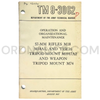
TM 9-3062 Technical Manual - 57mm M18, M18A1, and T15E16 Recoilless Rifles, M1917A2 Tripod Mount, and M74 Weapon Tripod Mount - August 1957
Item Overview
TM 9-3062 is an Army operation and organizational maintenance manual for the 57mm M18 rifle family and its tripod mounts. This August 1957 edition brings the weapons and their ground supports together in one reference. It suits collections focused on infantry support weapons, military technical literature, and early Cold War equipment.
Identification and Features
The title names three related rifle models and two separate tripod mounts. That coverage makes the manual useful for studying the equipment combinations used with the Army's portable 57mm recoilless weapons.
- Publication number: TM 9-3062
- Publication date: August 1957
- Issuing organization: Department of the Army
- Rifles covered: 57mm M18, M18A1, and T15E16
- Mounts covered: Tripod Mount M1917A2 and Weapon Tripod Mount M74
- Manual type: Operation and organizational maintenance
Function and Manual Contents
The manual addresses operation, routine care, and maintenance performed at unit level. Its combined rifle and mount coverage helps readers understand how the separate assemblies worked as a supported weapon system. It is a historical reference for studying equipment features and the Army's approach to keeping these weapons serviceable.
Publication History
This 1957 publication belongs to the period after the Korean War, when the Army continued to document weapons introduced during World War II. Its title preserves both the M-series service designations and the T15E16 designation. The inclusion of two mount types also records the range of support equipment covered by Army instructions.
Equipment History
The M18 grew from the T15 recoilless-rifle project at Frankford Arsenal's Pitman-Dunn Laboratory. A practical 57mm design took shape in 1943, followed by development trials and a major demonstration at Aberdeen Proving Ground in September 1944. The Army standardized the M18 in June 1945. Later Army data sheets grouped the M18 and M18A1 with the T15E16, which retained a limited-production classification.
M1917A2 and M74 Tripod Mount Background
The M1917A2 adapted the M1917A1 Browning machine-gun tripod for recoilless-rifle use. It retained the cradle design but used a shorter rear leg. Its folding legs could be adjusted separately to suit the ground. Army data sheets described it as an interim mount for 57mm and 75mm recoilless rifles, with the M74 intended to replace it.
Parent Weapon-System Background
The M18 was developed to give infantry troops portable cannon firepower. Its recoilless design released propellant gases through the rear of the breech to counter the forces that normally produce recoil. This reduced the need for a heavy recoil mechanism and carriage. High-explosive, antitank, and smoke ammunition gave the 57mm system several infantry support roles.
History of Use
Early 57mm recoilless rifles reached the European Theater in March 1945, and the M18 family saw late-war use in both Europe and the Pacific. The weapon served again during the Korean War from 1950 to 1953. Its portability made it part of the infantry's support arsenal alongside machine guns, mortars, and larger recoilless rifles.
Ideal For
This manual complements a recoilless-rifle reference library and supports research into period weapon-and-mount combinations. It also suits museum displays explaining the operating and maintenance work behind infantry fire support.
- Collectors of M18-series recoilless-rifle manuals
- Researchers studying M1917A2 and M74 tripods
- Military museums and infantry-weapons displays
- Historians of World War II and Korean War equipment
Approx length 6", Approx width 9", Approx height .5", Approx weight 1lbs.
Pictures are stock images of our inventory. Unless otherwise noted, you will not be receiving the exact item shown in the pictures. The pictures are representative of the item’s general condition. The item you receive might be slightly better, or worse, condition than was shown in the pictures.
Please visit our page about order lead times here: Order Lead Times.