


Description
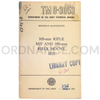
TM 9-3053 Technical Manual - 105mm M27 Recoilless Rifle and M75 Rifle Mount - February 1954
Item Overview
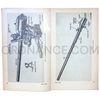
Study an early Cold War infantry support weapon with TM 9-3053. This February 1954 U.S. Army technical manual covers the 105mm M27 recoilless rifle and its M75 rifle mount. Its focus on both assemblies makes it a useful reference for military manual collectors, ordnance historians, and restoration researchers.
Identification and Features
These details identify the publication and the equipment it covers.
- Publication number: TM 9-3053
- Publication date: February 1954
- Issuing service: Department of the Army
- Manual category: Ordnance Maintenance
- Weapon covered: 105mm M27 recoilless rifle
- Mount covered: M75 rifle mount
Function and Manual Contents
This is an ordnance maintenance reference for the M27 weapon assembly and M75 mounting system. It supports research into how the rifle and mount were serviced as separate but linked parts. Collectors can use its equipment coverage alongside vehicle manuals when studying component identification, repair history, and period gun installations.
Documented End-Item Application
The M75 mount supported the M27 recoilless rifle in vehicle-mounted installations. Period Army data describes an adapter attached to the mount's lower carriage for truck mounting, including jeep applications. Army organization tables also identify the M27 on the M75 mount as equipment for infantry battalion heavy weapons companies.
Publication History
The Army's technical manual index dates TM 9-3053 to February 12, 1954. Issued shortly after the Korean War armistice, it belongs to the early Cold War period of support for the M27 system. Its ordnance maintenance focus records the technical support needed to keep the rifle and mount in service.
Equipment History: The M27 Recoilless Rifle
The M27 grew from Frankford Arsenal's T19 project, which was demonstrated during World War II in 1944. Development stopped in 1947 and resumed in February 1950. Further testing led to the T19 becoming the M27, an interim standard 105mm recoilless rifle. Its breech and firing mechanisms followed the general pattern of the smaller 75mm M20, linking the weapon to earlier American recoilless rifle development.
M75 Rifle Mount History and Design
The M75 combined upper and lower carriage assemblies with an elevating mechanism, a counterbalance, and a traveling lock. Its steel vehicle adapter secured the mounting system to the carrying vehicle. These parts supported the heavy rifle, helped the crew position it, and secured it for travel. The mount was an essential part of making a large recoilless weapon practical for mobile infantry support.
Weapon-System Background
Recoilless rifles vent propellant gas to the rear to balance much of the force created as the projectile moves forward. This reduces the need for a heavy recoil system. The M27 expanded the Army's wartime experience with the 57mm M18 and 75mm M20. Later development produced the M40 family, designated 106mm to distinguish its ammunition from the incompatible 105mm M27 rounds.
History of Use
The M27 saw combat during the Korean War of 1950–1953. Its antitank and antipersonnel roles gave infantry a large-caliber weapon for direct fire support. Vehicle mounting let units move the rifle with light transport, while its place in heavy weapons companies tied it closely to infantry battalion operations.
Ideal For
A focused reference for those collecting, preserving, or studying early Cold War recoilless weapons and their mounting systems.
- U.S. Army technical manual collectors
- M27 rifle and M75 mount restoration researchers
- Korean War ordnance historians
- Museums interpreting infantry antitank weapons
- Researchers studying military equipment in avalanche control
Approx length 6", Approx width 9", Approx height .2", Approx weight .4lbs.
Pictures are stock images of our inventory. Unless otherwise noted, you will not be receiving the exact item shown in the pictures. The pictures are representative of the item’s general condition. The item you receive might be slightly better, or worse, condition than was shown in the pictures.
Please visit our page about order lead times here: Order Lead Times.