



Description
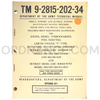
TM 9-2815-202-34 – GMC 8V71T Diesel Engine Technical Manual, September 1971 Reprint with Changes 1 and 2
TM 9-2815-202-34 is the September 1971 Army maintenance manual for GMC Series 8V71T diesel engines, Models 7083-7398 and 7083-7399. This official reprint includes the current pages from Changes 1 and 2 within the manual. Its subject is the engine equipment that powered several Cold War artillery and recovery vehicles.
Identification and Features
The publication identifies the covered equipment as diesel engine assemblies with containers. Its model numbers and Federal Stock Numbers, or FSNs, distinguish these military versions within the wider Detroit Diesel engine family.
- Publication number: TM 9-2815-202-34.
- Edition date: September 1971.
- Publisher: Headquarters, Department of the Army.
- Publication type: Direct and general support maintenance manual.
- Printing status: Official reprint with current pages from Changes 1 and 2.
- Engine series: GMC 8V71T.
- Model 7083-7398: FSN 2815-762-4500 and FSN 2815-936-7659.
- Model 7083-7399: FSN 2815-134-4845.
Function and Contents
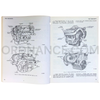
The manual guides support-level engine repair, including taking apart assemblies, inspecting parts, completing repairs, and rebuilding engines to Army standards. Its mechanical subjects include the cylinder heads, pistons, crankshaft, blower, turbocharger, and fuel, cooling, and lubrication systems. These subjects explain the relationship between major engine parts and the work needed to restore them to service. Direct and general support shops handled these larger repair jobs beyond routine crew maintenance.
Publication History
The Army issued this edition on September 17, 1971, during the continued service of its diesel-powered artillery fleet. Numbered changes kept the maintenance text updated as technical guidance developed. The later TM 9-2815-202-34&P, dated August 1980, superseded the 1971 manual and its changes. That publication record places this edition between the earlier Cold War engine references and the expanded support literature of the 1980s.
Documented Applications
Military references connect the 8V71T engine family to both self-propelled artillery and armored recovery equipment. The vehicles below establish its documented service background. Individual installations used different engine arrangements, so the complete model number remains important when matching a vehicle to its maintenance literature.
- M108: 105mm self-propelled howitzer.
- M109: 155mm self-propelled howitzer.
- M107: 175mm self-propelled gun.
- M110: 8-inch self-propelled howitzer.
- M578: Light armored recovery vehicle.
Equipment History
The military 8V71T brought Detroit Diesel's established engine design into the Army's growing fleet of diesel-powered tracked vehicles. Its use in artillery carriers and recovery equipment created a need for repair guidance that applied across several vehicle types. Models 7083-7398 and 7083-7399 shared the basic engine design but differed in how some components were arranged. By the time of this edition, support shops needed references for maintaining these engines through continued service and rebuilding.
Manufacturer Background
Detroit introduced the Series 71 engine family in 1938. During World War II, these diesels served military needs that included tanks, landing craft, construction equipment, and power generation. Detroit reports that its workforce built 57,892 Series 71 engines in 1943 alone. After the war, the family also reached a broad commercial market, including heavy trucks. The GMC military engines covered here grew from that long-running General Motors diesel program.
Engine Design and Performance
The 8V71T is an eight-cylinder, two-cycle diesel with fuel injection and liquid cooling. A blower supplies fresh air to the cylinders, while the turbocharger uses exhaust energy to increase the air supply. Army data for Model 7083-7398 in the M578 lists 567.4 cubic inches of displacement, about 9.3 liters. That vehicle reference rates the engine at 405 gross horsepower and 345 net horsepower at 2,300 rpm, placing it in the power range needed for heavy tracked equipment.
Parent Equipment History
The associated artillery vehicles formed part of the Army's early-1960s modernization of mobile fire support. Tracked weapon carriers could move with mechanized forces without a separate towing vehicle. The M107 and M110 used a common carriage design that could carry different artillery pieces. The M578 filled a support role with a crane and winches for lifting or towing disabled equipment. Together, these vehicle types show why engine maintenance was central to both artillery mobility and recovery work.
Weapon-System Background
The artillery systems served different fire-support needs. The M108 carried a light howitzer, while the M109 supplied heavier fire for area coverage and support of ground units. The M107's long-range gun could cover large areas, and the M110's heavy howitzer was valued for accurate fire. Their engines moved the weapon carriers between positions. Keeping those powerplants serviceable helped artillery units remain mobile as their firing locations and support needs changed.
History of Use
The M108, M109, M107, and M110 all saw service during the Vietnam War. Army histories describe the M108 in area support and the M109 in both general coverage and direct support of ground forces. Heavy artillery formations used the M107 and M110 according to the range and firepower needed. In Europe, the M109 also replaced the M108 in the artillery support role for armored and mechanized divisions. This manual dates from that period of active use and ongoing equipment maintenance.
Ideal For
This edition suits collectors who organize military publications by date, model coverage, and revision status. Engine historians can use it to study the Army's treatment of the 8V71T, while vehicle researchers can place it beside the related artillery and recovery manuals. It also supports museum research into the maintenance work behind Cold War tracked equipment.
- Army technical manual collectors.
- Detroit Diesel and GMC engine historians.
- Military vehicle restoration libraries.
- Cold War and Vietnam-era museum collections.
Approx length 8", Approx width 11", Approx height 1", Approx weight 2lbs.
Pictures are stock images of our inventory. Unless otherwise noted, you will not be receiving the exact item shown in the pictures. The pictures are representative of the item’s general condition. The item you receive might be slightly better, or worse, condition than was shown in the pictures.
Please visit our page about order lead times here: Order Lead Times.