


Description
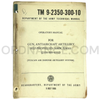
TM 9-2350-300-10 XM163 20mm Vulcan Self Propelled Antiaircraft Artillery Gun Manual
Publication Overview
TM 9-2350-300-10 is a U.S. Army operator's manual for the 20mm XM163 Self Propelled Antiaircraft Artillery Gun. This July 1968 publication documents crew guidance for the early tracked Vulcan system and is a period reference for studying the weapon and its carrier.
Identification & Features
The publication number, equipment designation, and included revisions identify this copy within the Army's Vulcan technical manual series.
- Technical manual: TM 9-2350-300-10
- Base publication date: July 1968
- Equipment: 20mm XM163 Self Propelled Antiaircraft Artillery Gun
- Federal Stock Number: FSN 2350-999-4392
- Publication role: Operator's manual
- Integrated update: Change 1, dated January 22, 1969
- Integrated update: Change 2, dated June 6, 1969
Function & Contents
The manual addresses crew operation of the weapon installation and its tracked carrier. Army maintenance articles cite this edition for chassis operating instructions, ammunition handling, and cautions concerning the suspension lockout system. These subjects help explain the duties assigned to a Vulcan crew and the connection between the gun equipment and the vehicle that carried it.
Integrated Changes 1 & 2
The current pages from Change 1, dated January 22, 1969, and Change 2, dated June 6, 1969, are integrated throughout this manual. The revised material appears within the relevant sections of the July 1968 publication. This change level is useful when comparing editions or matching the text to period references that cite a specific revision.
Publication History
The July 1968 issue dates from the Army's early Vulcan program, when production equipment was moving into testing. Contemporary Army reporting noted that the first production Vulcan units had been delivered for tests during fiscal year 1968. The manual formed part of the technical documentation needed to support the new system as it reached troops.
Documented Applications
The listed application is the XM163 under FSN 2350-999-4392. Its gun installation was mounted on the XM741 tracked chassis. An Army transmission parts manual issued in December 1968 specifically identifies the XM741 as a chassis for the XM163 weapon system. That record helps researchers connect this publication with the correct vehicle in period equipment documents.
Equipment History
The XM163 grew from the Army's efforts during the 1960s to strengthen mobile air defense. After the Mauler program was discontinued, the Army continued developing Vulcan equipment for forward units. XM163 was the early development designation for the tracked gun later known in service as the M163. The wider development program also included the XM167 towed Vulcan, giving the Army both tracked and towed forms of the weapon.
Parent Equipment History
The XM741 chassis was based on the M113A1 armored personnel carrier. The M113 family entered service in 1960 and used aluminum armor to help limit weight. The M113A1 introduced diesel power. This vehicle family became the basis for mortar carriers, command posts, and other specialized Army equipment. For Vulcan, it supplied a mobile tracked platform that could travel with the forces it supported.
Weapon-System Background
The XM163 combined a six-barrel 20mm Vulcan cannon with sighting equipment and radar that measured target range. Its rotating barrel cluster used the Gatling principle. The system was designed to defend troops against low-flying aircraft. Vulcan was developed alongside the Chaparral missile system as part of the Army's plan for air defense near the front lines.
History of Manual Use
In 1970, the Army's P.S. Magazine directed Vulcan crews to the July 1968 manual for ammunition-handling and carrier operating information. It also cited the January 1969 Change 1. These references document the manual's use as a working crew guide and show how the Army tracked revised instructions through numbered changes. For researchers, they connect the publication to practical service guidance of the period.
History of Military Use
During the Vietnam evaluation, Vulcans served on missions that included convoy protection, perimeter defense, and security for engineer work. The Army's campaign history also records a Vulcan being used during an ambush on Highway 13 on January 11, 1969. These accounts document the system's ground support role. Later M163 vehicles continued Army service, including shipment for Operation Desert Shield, extending the family's history beyond the XM163 development period.
Ideal For
This manual suits collections focused on early Vulcan vehicles, Vietnam-era Army publications, and Cold War air defense. Its integrated revisions are useful for building a dated reference collection, comparing Army crew guidance, or developing a museum display about the XM163's introduction and field use.
- Military technical manual collectors
- XM163 and Vulcan vehicle historians
- Owners and restoration researchers
- Museums preparing air defense displays
Approx length 8", Approx width 10.5", Approx height .5", Approx weight 1lbs.
Pictures are stock images of our inventory. Unless otherwise noted, you will not be receiving the exact item shown in the pictures. The pictures are representative of the item’s general condition. The item you receive might be slightly better, or worse, condition than was shown in the pictures.
Please visit our page about order lead times here: Order Lead Times.