


Description
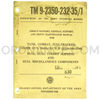
TM 9-2350-232-35/1 – 152mm M60A1E2 Full Tracked Combat Tank Hull Maintenance Manual, November 1968
Publication Overview
TM 9-2350-232-35/1 is the November 1968 technical manual for the hull of the 152mm M60A1E2 full tracked combat tank. This U.S. Army publication is a direct support, general support, and depot maintenance manual. The volume belongs to the technical literature for the development program that later produced the M60A2.
Identification and Features
The manual number, issue date, and vehicle designation identify this publication within the Army's M60 technical series. The Federal Stock Number, or FSN, refers to the tank covered by the book. These details help match the volume to period equipment records and related maintenance references.
- Publication: TM 9-2350-232-35/1
- Publication date: November 1968
- Vehicle: M60A1E2 full tracked combat tank
- Primary subject: Hull maintenance
- Main armament of the vehicle: 152mm gun/launcher
- Vehicle FSN: 2350-930-3590
- Maintenance levels: Direct support, general support, and depot
Function and Contents
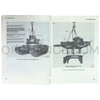
This volume concerns hull maintenance at the support and depot levels. The hull is the tank's main armored body, which houses the driver's position and major automotive equipment while supporting the turret. The publication's repair role places it within the guidance used by maintenance shops and major repair facilities. For researchers, its subject connects the M60A1E2's structural and automotive foundation with the Army's system of assigned maintenance responsibilities.
Publication History
The November 1968 issue dates from a period when the M60A1E2 was still undergoing development and engineering work. Its designation records that stage of the program before the tank became known as the M60A2. Hull publications formed part of the support literature needed for the vehicle's mechanical foundation. This edition helps researchers place early maintenance documentation within that changing development record.
Documented Applications
The identified end item is the M60A1E2 under FSN 2350-930-3590. Contemporary Army references also list this vehicle in shared hull-parts literature covering the wider M60 equipment family. That documented connection is useful when organizing component records and restoration references. The model name and stock number help connect the hull manual to the correct vehicle configuration and period.
Equipment History
M60A1E2 development began in 1964. The tank combined the M60A1 chassis with a new compact, fully stabilized turret for its 152mm gun/launcher. Production began in 1966, but stabilization and control-system problems delayed field use. A declassified May 1969 defense record describes continued work to solve these faults after further production had been postponed late in 1968.
Parent Equipment History
The M60 family evolved from the earlier M48 tank design. The Army adopted the 105mm M68 gun and redesigned the hull to improve protection against newer Soviet tanks. In the early 1960s, the M60A1 introduced a larger turret with improved ammunition storage. Its established chassis became the foundation for the M60A1E2, allowing the Army to develop new armament around an existing tank platform.
Weapon-System Background
The M60A1E2's 152mm gun/launcher could fire conventional ammunition or launch Shillelagh guided antitank missiles. The combined system was intended to give tank crews both conventional gunfire and guided engagements against enemy armor. Turret stabilization and control equipment were important parts of that concept. The hull supplied the protected, mobile platform on which the weapon and its crew depended.
History of Testing and Evaluation
A 1969 Army ARMOR report described plans to install prototype electric gun stabilizers on the M60A1E2 for evaluation. The system was designed to compensate for rapid hull movement as the tank traveled over terrain. A February 1972 Military Review report later described M60A1E2 service testing at Fort Knox, Kentucky. These contemporary records show continued evaluation of the relationship between vehicle movement and weapon control.
History of Military Use
The program led to the M60A2, which entered Army unit testing at Fort Hood in July 1973. Trials compared an M60A2 battalion with an M60A1 battalion over the following year. M60A2s reached Army units in Europe in 1975, where maintenance and reliability remained concerns. In May 1980, the Army approved a recommendation to withdraw the tanks from active service.
Ideal For
This manual suits collectors building a library of early M60 technical publications and researchers studying the M60A1E2 hull. Restoration researchers can use it when organizing period repair literature and matching vehicle records. Museums and military archives can place it alongside operator's and turret manuals to explain the support work behind the Army's gun-and-missile tank program.
- Military technical manual collectors
- M60A1E2 and M60A2 researchers
- Cold War armor historians
- Museums and military vehicle archives
Approx length 8", Approx width 10", Approx height .15", Approx weight .2lbs.
Pictures are stock images of our inventory. Unless otherwise noted, you will not be receiving the exact item shown in the pictures. The pictures are representative of the item’s general condition. The item you receive might be slightly better, or worse, condition than was shown in the pictures.
Please visit our page about order lead times here: Order Lead Times.