


Description
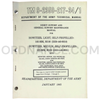
TM 9-2350-217-34/1: 105mm M108 and 155mm M109 / M109A1 / M109A3 Self Propelled Howitzer Maintenance Manual - January 1965
Publication Overview
TM 9-2350-217-34/1 is a U.S. Army direct support and general support maintenance manual for the M108 and M109 family of self propelled howitzers. Volume 1 focuses on the hull, suspension, final drives, and miscellaneous vehicle components. It addresses the mechanical foundation of these artillery vehicles and the repair work needed to keep their tracked platforms in service.
Identification and Features
The stock numbers below identify the complete howitzers covered by this updated publication. Federal Stock Numbers, or FSNs, were the older supply identifiers; National Stock Numbers, or NSNs, use the later 13-digit format. This official reprint includes the current pages from Changes 1 through 5, bringing the revised information into the manual.
- Manual: TM 9-2350-217-34/1
- Base publication date: January 1965
- Format: Official reprint
- Included updates: Current pages from Changes 1 through 5
- M108: 105mm self propelled howitzer, FSN 2350-440-8810
- M109: 155mm self propelled howitzer, FSN 2350-440-8811
- M109A1: 155mm self propelled howitzer, NSN 2350-00-485-9662
- M109A3: 155mm self propelled howitzer, NSN 2350-01-031-8851
Function and Contents
This volume concentrates on repair information for the vehicle's hull, suspension, final drives, and related components. The hull forms the main body, while the suspension supports the vehicle and its running gear. The final drives are gear units that carry power to the tracks. This coverage helps readers study the assemblies that support the howitzer's weight and allow it to move.
Publication History
The January 1965 edition dates from the early service years of the M108 and M109. Army technical manuals were revised as service experience and vehicle changes required new information. This reprint retains the base issue date and incorporates five later changes. Its M109A3 coverage reflects the continuing revision process as the artillery family developed during the late 1970s and 1980s.
Documented Applications
The listed end items include the light 105mm M108 and the medium 155mm M109, M109A1, and M109A3. The manual served direct support and general support maintenance personnel carrying out more involved repair work than routine crew servicing. Its vehicle-component focus is useful when studying workshop support for these models. The individual designations and stock numbers help match the reference to the correct howitzer.
M108 Equipment History
The M108 entered Army service in the early 1960s as a replacement for the M52 105mm self propelled howitzer. Its welded aluminum hull and turret were closely related to the M109 design. Production ended in 1963 as the Army favored the heavier 155mm weapon, and the M108 was phased out of U.S. Army service in the early 1970s.
M109 and M109A1 Equipment History
The first M109s were issued to the U.S. Army in June 1963. Developed to replace the M44, the new vehicle offered greater range and a wider field of fire. The original M109 carried a short 155mm howitzer. The later M109A1 introduced the longer M185 cannon for greater reach, extending the capabilities of the tracked platform while keeping the family's role in mobile artillery support.
M109A3 Equipment History
The M109A3 came from rebuilding existing M109A1 vehicles with improvements associated with the M109A2 program. Letterkenny Army Depot carried out conversions from 1979 through 1984. The work added features designed to improve reliability and ease maintenance, along with increased ammunition storage and an improved gun mount. This program extended the useful life of older vehicles while bringing them closer to the newer production standard.
Weapon-System Background
Self propelled howitzers combine an artillery weapon with a powered, tracked vehicle so the gun can move with the forces it supports. The M108 and M109 family delivered indirect fire against targets beyond the crew's direct view. Their rotating turrets allowed a full circle of fire. A sound hull, suspension, and drive system remained essential to moving these weapons between firing positions and supporting field operations.
History of Military Use
The M108 and original M109 saw combat in Vietnam. Two Army field artillery battalions used the M108, while Army and Marine Corps units employed the M109. The 2nd Battalion, 35th Artillery brought the first M109 unit to Vietnam in June 1966. The M109A1 continued the family's Cold War service, and M109A3 howitzers later served during Operation Desert Storm in 1991.
Ideal For
Keep this volume alongside the operating manuals and parts references for these howitzers to build a fuller technical library. Its focus on the vehicle's mechanical systems is useful for restoration research, component identification, and studying military repair practices. The model coverage also helps collectors follow the development of the M108 and M109 family across several decades of service.
- Military technical manual collectors
- M108 and M109 series restoration researchers
- Cold War, Vietnam War, and Gulf War historians
- Museums and military vehicle reference libraries
Approx length 8", Approx width 11", Approx height 1", Approx weight 2lbs.
Pictures are stock images of our inventory. Unless otherwise noted, you will not be receiving the exact item shown in the pictures. The pictures are representative of the item’s general condition. The item you receive might be slightly better, or worse, condition than was shown in the pictures.
Please visit our page about order lead times here: Order Lead Times.