




Description
TM 9-2350-217-20 Organizational Maintenance Manual for 105mm M108 and 155mm M109 / M109A1 Self-Propelled Howitzers – January 1965
Publication Overview
TM 9-2350-217-20 is the U.S. Army organizational maintenance manual for the M108, M109 and M109A1 self-propelled howitzers. Organizational maintenance means the upkeep and repairs assigned to the unit operating the equipment. Written for maintenance personnel, this official reprint preserves a working reference for the mechanical and electrical systems of these early tracked artillery vehicles.
Identification and Features
The Federal Stock Numbers, or FSNs, identify the complete vehicles covered by this publication. The edition date and incorporated changes distinguish this copy within the Army’s series of howitzer technical manuals.
- Publication: TM 9-2350-217-20, Organizational Maintenance Manual
- Base edition: January 1965
- Revision status: Official reprint with current pages from Changes 1 through 10
- 105mm M108: FSN 2350-440-8810
- 155mm M109: FSN 2350-440-8811
- 155mm M109A1: FSN 2350-485-9662
Function and Contents
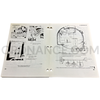
The manual explains inspections, servicing, adjustments and repairs assigned to unit maintenance personnel. Its coverage includes the weapon, turret and tracked vehicle, with illustrated views of mechanical assemblies, electrical equipment and hydraulic systems. A maintenance allocation chart identifies the work assigned to different maintenance levels. These instructions help readers study both component layouts and the Army’s system for caring for the complete howitzer.
Publication History
The January 1965 base edition dates from the early service years of the M108 and M109. The Army’s February 1969 PS Magazine cited this edition for electrical checks and directed mechanics to Change 3 for updated rectifier information. Later changes revised the instructions as equipment evolved. The supplied reprint retains the original edition date while incorporating revised coverage that includes the M109A1.
Documented Applications
The covered equipment spans the light 105mm M108 and the medium 155mm M109 and M109A1. Each combines a diesel-powered tracked vehicle with a turret-mounted howitzer. The M108 and M109 used closely related hull and turret designs, making shared assemblies an important part of their maintenance history. Model notes and component illustrations help readers follow the differences between the covered vehicles.
M108 Equipment History
The M108 entered U.S. Army service in the early 1960s as a replacement for the M52 self-propelled howitzer. Cadillac Motor Car Division of General Motors produced 355 vehicles. Production ended in 1963 as the Army favored the greater firepower of the 155mm M109. The M108 was gradually phased out of U.S. Army service during the early 1970s.
M109 and M109A1 Equipment History
The first M109s reached the Army in June 1963. The design answered a need for greater range and a wider field of fire than the older M44. The original M109 carried a short 155mm cannon. The M109A1 received the longer M185 cannon, increasing range while keeping the basic vehicle layout. This development helped establish the M109 family’s long history of upgrades.
Weapon-System Background
Self-propelled artillery was designed to keep fire support close to mobile ground forces. Its main role was indirect fire against targets beyond the crew’s direct view. These howitzers carried their guns in enclosed turrets that could turn through a full circle. Their crews relied on the vehicle’s drive systems, gun controls and sighting equipment working together, making reliable maintenance central to their field role.
History of Maintenance Use
The Army’s 1974 field manual FM 6-88 directed artillery units to TM 9-2350-217-20 for additional inspections and servicing of the weapon, turret and vehicle. It also specifically cited the maintenance allocation chart. This placed the publication alongside the operator’s manual and lubrication order within the Army’s maintenance program. The reference helped define the work assigned to unit personnel during training and field service.
History of Military Use
The M108 and original M109 saw combat during the Vietnam War. Two U.S. Army field artillery battalions used the M108, while M109s served with both Army and Marine Corps units. The Army’s first M109 unit in Vietnam, the 2nd Battalion, 35th Artillery, arrived in June 1966. These vehicles supported troops from firebases. The M109A1 later served with U.S. and allied forces during the Cold War, extending the family’s role in mobile artillery support.
Ideal For
Collectors can pair this edition with operator’s manuals and repair-parts references for the same vehicles. Restoration researchers can use its component views and period terminology when studying early howitzer systems. Historians and museum staff can compare the Army’s maintenance instructions with unit records to better understand the work behind artillery service.
- U.S. Army technical manual collectors
- M108, M109 and M109A1 restoration researchers
- Cold War and Vietnam War historians
- Military museums and reference libraries
Approx length 8", Approx width 11", Approx height 1.5", Approx weight 3lbs.
Pictures are stock images of our inventory. Unless otherwise noted, you will not be receiving the exact item shown in the pictures. The pictures are representative of the item’s general condition. The item you receive might be slightly better, or worse, condition than was shown in the pictures.
Please visit our page about order lead times here: Order Lead Times.