



Description
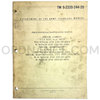
TM 9-2320-244-20 Technical Manual for M715 Cargo, M725 Ambulance and M726 Maintenance Trucks – August 1971
Item Overview
TM 9-2320-244-20 is the August 1971 U.S. Army organizational maintenance manual for the M715 cargo truck, M725 ambulance truck and M726 maintenance truck. It covers the 1-1/4-ton, 4x4 Kaiser Jeep truck family often called the “Five Quarter.” This publication is a useful reference for owners restoring these vehicles, researchers studying Army motor pools and collectors building a Vietnam-era technical manual library.
Identification and Features
The cover identifies five vehicle configurations by Federal Stock Number, or FSN. These numbers distinguish each truck’s role and winch equipment, helping readers match the publication to the correct vehicle.
- Publication number: TM 9-2320-244-20
- Publication date: August 1971
- Publisher: Headquarters, Department of the Army
- Maintenance level: Organizational maintenance
- Vehicle class: 1-1/4-ton, 4x4 trucks
- M715 cargo truck without winch: FSN 2320-921-6365
- M715 cargo truck with winch: FSN 2320-921-6366
- M725 ambulance truck without winch: FSN 2320-921-6369
- M726 maintenance truck without winch: FSN 2320-921-6370
- M726 maintenance truck with winch: FSN 2320-921-6833
Function and Contents
This manual guides the maintenance work assigned to mechanics within the using unit. Its contents cover service upon receipt, lubrication, preventive checks and troubleshooting. Repair sections address the engine, clutch, fuel and exhaust systems, cooling, ignition, starting and charging equipment, batteries, lights and instruments. Other sections cover the transmission, transfer case, drive shafts, axles, suspension, steering, brakes, wheels, cab and body. Accessory coverage includes the winch and power takeoff, deep-water fording equipment, 100-ampere alternator kit, arctic enclosure, heater and defroster. Storage guidance, torque requirements and technical illustrations support the maintenance instructions.
Publication History
The August 1971 edition superseded TM 9-2320-244-20 dated October 28, 1968, including all changes, and TB 9-2320-244-20 dated July 18, 1968. It brought the Army’s organizational maintenance guidance into a later edition while the trucks remained in service. The publication belongs to a wider manual series, with separate volumes for operators, repair parts and support-level maintenance. Its date places it after the main production run and within the period when Army units were maintaining the existing fleet.
Documented Applications
The M715 served as a cargo and troop transport truck, with an open rear bed that could carry supplies or fitted troop seats. The M725 used an enclosed ambulance body with rear access doors, a patient compartment and litter equipment. The M726 was a telephone maintenance truck, fitted with a utility body for field communications work. Its storage compartments and open cargo area supported the transport of tools and equipment. The manual addresses the shared vehicle systems and the body or accessory differences that affect maintenance across these three applications.
Equipment History
Kaiser Jeep developed this truck family from the civilian Jeep Gladiator pickup. Development began in the mid-1960s, and production ran from 1967 through 1969 at Toledo, Ohio. The military versions used a 230-cubic-inch, six-cylinder gasoline engine with an overhead camshaft. A four-speed manual transmission, two-speed transfer case and four-wheel drive formed the drivetrain. The engine was rated at 132.5 horsepower at 4,000 rpm.
Weapon-System Background
The M715 family formed part of the transport and support system behind combat units. It followed the Dodge M37 family as the Army sought a less costly truck based on commercial components. Military equipment included a 24-volt electrical system, blackout lighting and towing fittings. The different bodies supported supply movement, casualty evacuation and telephone maintenance. These roles made the trucks part of the equipment network that kept troops, medical services and field communications working during Cold War operations.
History of Use
The M715 family served during the Vietnam War, including M725 ambulances used for medical transport. Army training also supported the fleet: a June 1968 account describes the production of an M715 instructional film for mechanics, filmed at the Kaiser Jeep plant, a proving ground and the Detroit Arsenal. The trucks remained in Army inventories into the 1970s. The Army’s fiscal year 1975 historical summary recorded a commercial-truck replacement program scheduled to begin in 1976, marking the move toward a newer light truck fleet.
Ideal For
The model coverage and maintenance focus make this manual a practical addition to vehicle reference shelves and military history collections.
- M715 cargo truck restorations
- M725 ambulance restorations
- M726 telephone maintenance truck projects
- Kaiser Jeep military vehicle collections
- Vietnam-era motor pool research
- U.S. Army technical manual libraries
Approx length 8", Approx width 11", Approx height .5", Approx weight 1lbs.
Pictures are stock images of our inventory. Unless otherwise noted, you will not be receiving the exact item shown in the pictures. The pictures are representative of the item’s general condition. The item you receive might be slightly better, or worse, condition than was shown in the pictures.
Please visit our page about order lead times here: Order Lead Times.