


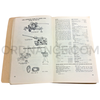

Description
TM 9-2300 Artillery Materiel and Associated Equipment Technical Manual – May 1949
Item Overview
This Department of the Army Technical Manual is an illustrated reference to the artillery weapons, sighting instruments, and fire-control equipment found in the U.S. Army ordnance supply system after World War II. Published on May 3, 1949, TM 9-2300 records the major characteristics, purposes, and performance of equipment that remained important during the early postwar period. This listing is for the technical manual only; the weapons and equipment shown in its pages are not included.
Publication Details
This edition combines technical data and illustrations for many different artillery and fire-control equipment families within one reference volume.
- Manual number: TM 9-2300
- Official title: Artillery Materiel and Associated Equipment
- Issuing authority: Department of the Army
- Publication date: May 3, 1949
- Historical period: Early Cold War and post-World War II
- Printed length: Approximately 244 pages
- Format: Illustrated technical reference manual
- Primary subjects: Artillery weapons, mounts, carriages, combat-vehicle armament, sights, and fire-control equipment
Publication History
This May 1949 edition followed the February 1944 TM 9-2300 titled Standard Artillery and Fire Control Materiel. The revised publication reflects equipment developed, standardized, or retained through the final years of World War II and the immediate postwar period. Its updated title and expanded coverage show the Army’s effort to create a current reference for the large collection of weapons and fire-control devices still held in the ordnance supply system.
Purpose and Contents
TM 9-2300 was prepared as a general data and identification manual rather than an operator’s guide for one weapon. Each major item is presented with information about its purpose, operating role, main characteristics, and performance. Photographs, drawings, and data tables help readers compare weapon types and recognize the supporting equipment used with them. The manual is especially useful for studying how individual guns, mounts, sights, and fire-control instruments were organized within the Army supply system.
Documented Applications
The manual covers materiel used for field artillery, antitank and recoilless-fire missions, antiaircraft defense, armored warfare, and self-propelled artillery. Equipment documented through this edition includes the M20 75mm recoilless rifle, M36 90mm gun motor carriage, M40 155mm gun motor carriage, M43 8-inch howitzer motor carriage, and M19 twin 40mm gun motor carriage. It also covers towed weapons, gun carriages, telescope mounts, binoculars, panoramic telescopes, plotting boards, directors, rangefinders, and mechanical gun-data equipment.
Towed Artillery Equipment History
The postwar Army retained many of the field guns and howitzers that had proven effective during World War II. Light and medium howitzers supplied mobile indirect fire, while larger 155mm, 8-inch, and 240mm weapons attacked distant or fortified targets. Towed artillery depended on a complete group of carriages, recoil systems, prime movers, ammunition equipment, sights, and maintenance tools. Manuals such as TM 9-2300 helped identify these related components and explain their place within each weapon family.
Recoilless and Infantry Artillery History
Recoilless rifles gave infantry units a lighter direct-fire weapon that could engage fortifications, vehicles, and other point targets. The M20 75mm recoilless rifle was developed near the end of World War II and became an important infantry-support weapon during the early Cold War. It could be fired from a tripod or vehicle mount, giving ground units more mobility than was possible with many conventional antitank guns.
Self-Propelled Artillery Equipment History
World War II proved the value of mounting artillery weapons on tracked vehicles. Systems such as the M40 155mm gun motor carriage and M43 8-inch howitzer motor carriage allowed heavy firepower to move with armored formations. Their open fighting compartments, rear-mounted weapons, and tracked chassis reflected the Army’s need for mobile artillery that could deploy faster than heavy towed guns. These vehicles remained important references during the transition from wartime equipment to a permanent postwar armored force.
Combat-Vehicle Armament History
The manual also documents weapons and sights associated with tanks, tank destroyers, and other armored vehicles. The M36 gun motor carriage used a powerful 90mm gun in the tank-destroyer role, while other vehicles carried howitzers or automatic cannon for fire support and air defense. Vehicle-mounted artillery combined the weapon, mount, recoil system, ammunition storage, powered or manual controls, and optical sights into a single mobile fighting system.
Antiaircraft Equipment History
Antiaircraft artillery remained an important part of Army defense after World War II. The M19 twin 40mm gun motor carriage placed two Bofors-type automatic guns on a tracked chassis for mobile protection against low-flying aircraft. Heavier antiaircraft guns depended on directors, range or height information, and coordinated fire-control crews. The equipment in TM 9-2300 records the period when optical and mechanical systems still guided most antiaircraft fire.
Fire-Control Equipment History
Accurate artillery fire required more than a gun and ammunition. Panoramic telescopes, direct-fire sights, binoculars, rangefinders, plotting boards, directors, and mechanical computers helped crews locate targets and calculate firing data. These instruments converted observations into elevation, direction, lead, and fuze information. The manual’s fire-control section is valuable because it connects specialized instruments with the artillery weapons and mounts they supported.
History of Use
Much of the materiel documented in this manual had served during World War II and continued into occupation duty, training, reserve service, and the Korean War era. Recoilless rifles supported infantry, gun motor carriages provided mobile direct fire, self-propelled artillery supported armored units, and antiaircraft systems protected troops and installations. Many American weapon designs were also supplied to allied nations, extending their service well beyond the period in which this manual was published.
Ideal For
This technical manual is a useful reference for collectors and researchers studying American artillery during the transition from World War II to the early Cold War.
- U.S. Army technical manual collectors
- World War II and Korean War historians
- Field and self-propelled artillery researchers
- Military vehicle and tank-destroyer collectors
- Fire-control and optical instrument collectors
- Museum and restoration reference libraries
- Military authors, archivists, and educators
Approx length 6", Approx width 9", Approx height .5", Approx weight 1lbs.
Pictures are stock images of our inventory. Unless otherwise noted, you will not be receiving the exact item shown in the pictures. The pictures are representative of the item’s general condition. The item you receive might be slightly better, or worse, condition than was shown in the pictures.
Please visit our page about order lead times here: Order Lead Times.