




Description
TM 9-2300-216-10 Operator’s Manual for M107 / T235E1 175mm Gun and M110 / T236E1 8-Inch Howitzer – June 1962
Item Overview
This U.S. Army technical manual covers the 175mm M107 self-propelled field artillery gun and the 8-inch M110 self-propelled howitzer. Written for vehicle operators and artillery crews, it explains the equipment they used to drive, handle, and care for these heavy weapons. The early issue carries both the standardized M-designations and the T-designations used during development, making it a useful reference for the first generation of these Cold War artillery systems.
Publication Details
The publication information identifies the edition, its intended operator-level role, and the equipment covered. The Federal Stock Numbers identify the two complete artillery vehicles named in the manual.
- Manual Number: TM 9-2300-216-10
- Publication Type: Department of the Army Technical Manual, Operator’s Manual
- Issue Date: June 1962
- Issuing Authority: Headquarters, Department of the Army
- Gun Application: 175mm M107 / T235E1 Self-Propelled Field Artillery Gun, FSN 2350-436-6635
- Howitzer Application: 8-Inch M110 / T236E1 Self-Propelled Heavy Howitzer, FSN 2350-439-6243
Function and Contents
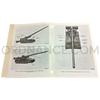
The manual’s illustrated coverage includes the driver’s controls and instruments, gunner’s controls, sighting equipment, hydraulic loader and rammer, rear recoil spade, and weapon travel locks. It also shows the engine and transmission layout, track-tension equipment, and fire-extinguisher system. Labeled photographs and drawings connect component names with their locations on the vehicle. These subjects explain the relationship between the tracked carrier and its mounted artillery equipment, giving readers a clear view of the driving, weapon-handling, and basic equipment-care tasks assigned to the crew.
Documented Applications
This edition applies to the original fully tracked M107 and M110 configurations named in its title. T235E1 was the development designation associated with the M107 gun, while T236E1 was associated with the M110 howitzer. These paired designations help researchers match early drawings and technical records to the standardized equipment names. The original M110 covered here used the short-barreled 8-inch howitzer installation. Its configuration is an important reference point when comparing early vehicles with later members of the M110 family.
Publication History
The June 1962 issue belongs to the Army’s early technical support for this heavy self-propelled artillery family. Related repair-parts manuals followed in July 1962, forming a set of references for operators and maintenance personnel. The Army later issued changes as the equipment remained in service. In November 1969, the Army’s Artillery magazine listed the June 1962 operator’s manual, with published changes, among the publications recommended for artillery batteries. This documented use connects the manual’s early publication date with its continued importance during the Vietnam era.
Equipment History
The M107 and M110 were part of the Army’s artillery modernization in the early 1960s. The M110 was introduced in 1963, and both vehicles used a common chassis with a diesel engine, tracked running gear, and torsion-bar suspension. Their open working decks gave crews access to the weapon and its loading equipment. A large rear spade helped steady the vehicle during firing. Later M110 development brought the longer-barreled M110A1 and the muzzle-brake-equipped M110A2, extending the life of the basic tracked platform through several equipment upgrades.
Weapon-System Background
The two systems met different heavy artillery needs. The M107 mounted the long 175mm M113 cannon and could reach targets almost 33 kilometers away, or about 20 miles. The original M110 fired an 8-inch projectile weighing about 200 pounds to a range of almost 17 kilometers, or about 10.5 miles. Army histories noted the 8-inch howitzer’s accuracy, while the 175mm gun’s greater reach allowed it to support troops across a wider area. The shared vehicle design let commanders select the weapon combination that best suited their fire-support needs.
History of Use
U.S. Army units used both systems during the Vietnam War, including service from established artillery positions and firebases. The 8-inch howitzer served with divisional artillery, while field-force artillery included both 8-inch howitzers and 175mm guns. Some batteries operated a mixture of the two weapons, and their common carriage allowed units to adjust that mix as tactical needs changed. These heavy systems relied on ground movement, ammunition supply, and support equipment for sustained service. Period photographs also document the M110 in field training. Across its three main models, the M110 family served the Army and Marine Corps for more than 30 years.
Ideal For
This manual preserves the equipment names, layouts, and operator-focused information used when the artillery family was new. It is useful for comparing period photographs, understanding surviving vehicles, and placing early technical records in their proper historical context.
- Military manual collectors building Cold War and Vietnam-era reference collections.
- Artillery historians researching the early M107 and M110 systems.
- Museum staff preparing vehicle displays and historical interpretation.
- Military vehicle owners seeking period documentation for the original configurations.
- Scale-model builders studying equipment layout and visible vehicle details.
Approx length 8", Approx width 10", Approx height .25", Approx weight 1lbs.
Pictures are stock images of our inventory. Unless otherwise noted, you will not be receiving the exact item shown in the pictures. The pictures are representative of the item’s general condition. The item you receive might be slightly better, or worse, condition than was shown in the pictures.
Please visit our page about order lead times here: Order Lead Times.