



Description
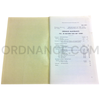
TM 9-2013 .30-Caliber M37 Tank Machine Gun Ordnance Maintenance Manual – January 1955
Item Overview
This original U.S. Army Technical Manual TM 9-2013 covers ordnance maintenance of the caliber .30 M37 tank machine gun. Published on January 7, 1955, it was written for personnel performing field and depot maintenance beyond the work normally assigned to vehicle crews and using organizations. Its illustrated instructions make it a valuable technical reference for studying, identifying, repairing, and restoring this Cold War armored-vehicle weapon.
Publication Details
The manual provides the official publication and maintenance information listed below.
- Manual Number: TM 9-2013
- Official Title: Ordnance Maintenance: Cal. .30 Machine Gun M37 (Tank)
- Publication Date: January 7, 1955
- Technical Information Current To: November 22, 1954
- Publisher: Department of the Army
- Maintenance Level: Field and depot maintenance
- Covered Weapon: Caliber .30 M37 tank machine gun
- Related Operator Manual: TM 9-2012
- Period: Early Cold War
Publication History
This January 1955 manual was the first TM 9-2013 edition and was issued soon after the companion TM 9-2012 operation and organizational maintenance manual of December 1954. TM 9-2012 covered operation, lubrication, and maintenance assigned to using organizations, while TM 9-2013 addressed the more advanced work performed by ordnance maintenance units, depot shops, and arsenals. Together, the publications supported the introduction and continued service of the M37.
Function and Contents
TM 9-2013 explains removal, disassembly, inspection, repair, rebuilding, assembly, and final testing of the M37 machine gun. Its chapters cover special tools, technical inspections, troubleshooting, repair standards, a rebuild flow chart, an operations route sheet, and final inspection requirements. Detailed procedures address the backplate, cover, bolt, lock frame, barrel, barrel extension, casing, receiver, firing mechanism, headspace adjustment, springs, and other major components.
Documented Vehicle Applications
The M37 was designed for installation in postwar American armored vehicles, with documented applications that include the M47 and M48 Patton tanks. Army equipment references also identify the M37 as a coaxial machine gun for the M103 120mm heavy tank. Installations and later replacement weapons varied by tank model, production period, user nation, and modernization program.
M37 Machine Gun History
The M37 was developed from the proven Browning M1919 family for use inside armored vehicles. It is an automatic, recoil-operated, link-belt-fed, air-cooled weapon chambered for caliber .30 ammunition. Parts within the cover, bolt, and feed opening could be repositioned to permit either left-hand or right-hand ammunition feeding, making the gun adaptable to different vehicle installations. Its compact controls and vehicle-oriented design made it better suited to confined turret spaces than earlier infantry configurations.
M47 Patton Tank Background
The M47 Patton was developed during the Korean War period by combining an improved turret with a chassis and power train based on the M46. Armed with a 90mm main gun, it became an important early Cold War tank for the United States and many allied nations. M37 machine guns are documented in connection with M47-series service and support, although weapon arrangements could change as tanks were modified by different operators.
M48 Patton Tank Background
The M48 Patton replaced the M47 as the United States Army’s primary medium tank during the 1950s. Unlike earlier tanks with a bow machine-gun position, the M48 placed its driver in the center of the hull and used the M37 as a turret-mounted coaxial weapon beside the main gun. Later M48 modernization programs replaced the caliber .30 M37 with weapons chambered for 7.62mm NATO ammunition.
M103 Heavy Tank Background
The M103 was a heavily armored American tank built around a powerful 120mm main gun. Its supporting armament included an M37 machine gun mounted coaxially with the cannon. The M103 served with the U.S. Army and Marine Corps during the Cold War, where it was intended to counter heavily armored enemy vehicles and support American armored formations.
Browning Weapon-System Background
The M37 retained the basic recoil-operated system that made Browning machine guns dependable through World War II and the early Cold War. Its design adapted that established mechanism for fixed or flexible vehicle use and allowed ammunition to feed from either side. Some M37 weapons were later converted to the M37E1 configuration for 7.62×51mm NATO ammunition before newer vehicle machine guns replaced the caliber .30 system.
History of Use
The M37 served during a period when the United States was building armored forces for service in Europe and other Cold War theaters. It supported tank crews during training, overseas deployments, gunnery exercises, and operational service. M47 and M48 tanks were supplied to numerous allied nations, while the M103 served in American heavy-tank units. Weapon fits changed as these vehicles were rebuilt or upgraded, making period maintenance manuals important references for identifying their original configurations.
Ideal For
This illustrated Army publication is well suited to several military-history and restoration interests.
- U.S. military technical manual collectors
- M37 machine gun owners and researchers
- M47 and M48 Patton tank restorers
- M103 heavy tank historians
- Browning machine gun collectors
- Cold War armored-vehicle displays
- Museums and educational collections
- Military small-arms research libraries
Approx length 6", Approx width 9", Approx height .25", Approx weight .5lbs.
Pictures are stock images of our inventory. Unless otherwise noted, you will not be receiving the exact item shown in the pictures. The pictures are representative of the item’s general condition. The item you receive might be slightly better, or worse, condition than was shown in the pictures.
Please visit our page about order lead times here: Order Lead Times.