



Description
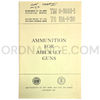
TM 9-1901-1 Ammunition for Aircraft Guns Technical Manual – December 1957
Item Overview
This period U.S. military technical manual covers ammunition used with caliber .50 aircraft machine guns and several 20mm automatic aircraft cannons. Published jointly by the Departments of the Army and Air Force, it is an illustrated reference for identifying, handling, packing, and using American aircraft-gun ammunition during the early Cold War.
Publication Details
The official title and publication data identify this as the December 1957 joint-service edition prepared for military instruction and technical reference.
- Army manual number: TM 9-1901-1
- Air Force technical order: TO 11A-1-39
- Official title: Ammunition for Aircraft Guns
- Issuing departments: Departments of the Army and the Air Force
- Publication date: December 18, 1957
- Information current through: August 21, 1957
- Calibers covered: Caliber .50 and 20mm
- Documented guns: 20mm M3, M24A1, M39, M39A1, and M61 (T171E3)
Manual Contents and Function
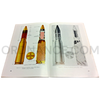
TM 9-1901-1 explains ammunition characteristics, classifications, standard nomenclature, Federal stock numbers, Department of Defense Identification Codes, color markings, explosive charges, and cartridge construction. Separate chapters cover caliber .50 and 20mm cartridges, fuzes, propelling charges, primers, ammunition links, packing, shipment markings, handling precautions, storage considerations, and demolition to prevent enemy use. Detailed tables, cartridge illustrations, and cutaway drawings help users identify complete rounds and internal components.
Documented Aircraft-Gun Applications
The manual covers fixed ammunition for caliber .50 aircraft guns and the 20mm M3, M24A1, M39, M39A1, and M61 aircraft cannons. Documented ammunition types include ball, armor-piercing, incendiary, tracer, armor-piercing incendiary, armor-piercing incendiary tracer, high-explosive incendiary, target-practice, dummy, blank, and high-pressure-test cartridges. It also distinguishes between percussion-primed ammunition for earlier 20mm guns and electric-primed cartridges used with later aircraft cannon systems.
Publication History
This edition superseded the aircraft-gun ammunition portions of TM 9-1901 and TO 11A-1-22 dated September 11, 1950, including Change No. 1 dated March 12, 1954. Its joint Army and Air Force designations reflect the effort to maintain common terminology, identification standards, supply information, and safety procedures for military aircraft ammunition.
Aircraft-Gun Ammunition History
The manual records a major transition in American aircraft armament. Caliber .50 ammunition remained important after World War II and during the Korean War, while faster jet aircraft increased the need for heavier 20mm cannon ammunition. The publication documents older M3 and M24A1 cartridge families alongside newer electric-primed ammunition developed for the M39-series guns and the rotating six-barrel M61.
Aircraft-Gun Equipment History
The M39 and M39A1 were gas-operated, belt-fed, electrically fired 20mm aircraft cannons intended for use against aircraft and surface targets. The M61 used a powered rotating six-barrel arrangement that produced a higher rate of fire. Although the M39, M39A1, and M61 used the same basic cartridge family, the M39-series guns used T61E3 disintegrating links while the M61 used T76 links. The manual clearly states that these links were not interchangeable.
Aircraft Armament System Background
Aircraft guns operated as complete systems combining the weapon, ammunition, cartridge links, feed equipment, ignition method, sights, and loading procedures. Correct ammunition identification was critical because cartridges for the M3 and M24A1 could not be fired in the M39, M39A1, or M61. Ammunition linked for the M61 also could not be fed through the M39-series guns, even though the individual cartridges were otherwise from the same ammunition family.
History of Use
Caliber .50 ammunition supported American fighters such as the F-86 Sabre during the Korean War. The M39 cannon family armed early Cold War aircraft including the F-100 Super Sabre, while the M61 developed into one of the most widely used American aircraft cannon families. Manuals of this type supported aircraft armorers, ammunition handlers, inspectors, instructors, and supply personnel responsible for identifying cartridges, preparing ammunition belts, loading weapons, and following safe handling procedures.
Condition
This listing is for the December 1957 edition identified above. Refer to the product photographs and any item-specific notes for the condition of the available manual, including its cover, binding, pages, markings, and signs of military or archival use.
Ideal For
- Collectors of U.S. Army and Air Force technical manuals
- Military aviation and Cold War historians
- Aircraft armament and ammunition researchers
- Museum reference libraries and restoration projects
- Collectors studying caliber .50 and 20mm aircraft ammunition
Approx length 6", Approx width 9", Approx height .2", Approx weight .4lbs.
Pictures are stock images of our inventory. Unless otherwise noted, you will not be receiving the exact item shown in the pictures. The pictures are representative of the item’s general condition. The item you receive might be slightly better, or worse, condition than was shown in the pictures.
Please visit our page about order lead times here: Order Lead Times.