



Description
Technical Manual TM 9-1659 for M5A1, M5A2, and M5A3 Antiaircraft Directors – July 1950
Item Overview
This July 1950 U.S. Army Technical Manual TM 9-1659 is the Ordnance maintenance publication for Directors M5A1, M5A2, and M5A3. These complex electromechanical instruments calculated firing data for short-range antiaircraft weapons. The manual documents the equipment at the transition between World War II and early Cold War air-defense service.
Manual Contents and Purpose
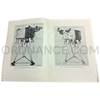
TM 9-1659 was prepared for trained Ordnance personnel responsible for maintaining the directors beyond routine crew-level care. Its scope covers the construction, operation, inspection, troubleshooting, disassembly, repair, assembly, adjustment, and testing of the mechanical, electrical, optical, and servo-operated components used in the three director models. Detailed illustrations helped maintenance personnel identify assemblies and understand how the calculating mechanisms worked together.
Identification and Features
This is the July 1950 Ordnance maintenance edition devoted to the later M5-series director group. Period records identify the publication as an approximately 430-page technical manual, making it much more extensive than the shorter operating and general-reference manuals issued for the same equipment.
- Manual number: TM 9-1659
- Publication date: July 1950
- Publication type: Ordnance maintenance technical manual
- Equipment covered: Directors M5A1, M5A2, and M5A3
- Primary weapon application: 40mm Automatic Gun M1 antiaircraft system
- Associated control equipment: Remote Control System M15
- Associated power equipment: Generating Unit M5
- Approximate length: 430 pages
Documented Weapon Applications
The M5A1, M5A2, and M5A3 directors were designed for use with the M15 remote-control system that powered the traverse and elevation mechanisms of 40mm antiaircraft guns. Period Army publications identify the director as the primary source of firing data for the 40mm Automatic Gun M1 on Carriages M2 and M2A1. A director crew tracked the target from a separate tripod-mounted position while electrical signals guided the gun toward the calculated firing azimuth and elevation.
Publication History
The July 1950 TM 9-1659 followed the December 1947 TM 9-659 publication for Directors M5A1, M5A2, and M5A3. TM 9-659 provided general description, operation, and crew guidance, while the 1950 TM 9-1659 supplied the more extensive Ordnance maintenance coverage required for repair shops. The 1950 edition should not be confused with the earlier May 1944 edition of TM 9-1659, which covered the older M5, M5A1, and M6 director group.
M5-Series Director Function
The directors were electromechanical analog fire-control computers that used optical tracking information and target range to calculate firing azimuth and quadrant elevation. The M5A1 relied on an operator to estimate and enter slant range, with tracer observation used to correct the estimate. The M5A2 and M5A3 incorporated an M10 rangefinder and servo system that continuously introduced measured range into the calculating mechanism. All three models transmitted their calculated data electrically to the gun’s remote-control equipment.
M5-Series Director History
The M5 family was developed during World War II to improve fire control against fast, low-flying aircraft within the range of automatic antiaircraft guns. The M5A1 combined mechanical computing mechanisms with optical tracking telescopes. The M5A2 added automatic range input from its mounted rangefinder, reducing the need for estimated range corrections. The M5A3 retained the same general arrangement but included changes to its tracking rates and response characteristics. These improvements allowed the director crew to follow a moving aircraft while continuously producing corrected gun-laying data.
40mm Antiaircraft Weapon-System Background
The American 40mm Automatic Gun M1 was based on the proven Bofors antiaircraft-gun design and filled the defensive role between heavy machine guns and larger 3-inch or 90mm antiaircraft artillery. It fired high-explosive and armor-piercing ammunition from four-round clips and could deliver rapid automatic fire against aircraft or ground targets. When connected to a director through the M15 remote-control system, the carriage could traverse and elevate under power instead of relying only on manual gun laying.
History of Use
M5-series directors served with U.S. antiaircraft automatic-weapons units during World War II and remained supported during the Korean War era. Director-controlled 40mm batteries protected airfields, ports, troop concentrations, supply areas, and other important positions from low-level air attack. The system required coordinated work by telescope trackers, range personnel, director operators, generator crews, and gun crews. The continued publication of a major Ordnance maintenance manual in 1950 shows that the Army still considered these directors important service equipment during the opening years of the Cold War.
Condition
This listing is for the July 1950 technical manual only. The M5A1, M5A2, or M5A3 director, M10 rangefinder, tripod, generating unit, remote-control equipment, and 40mm antiaircraft gun are not included.
Ideal For
This detailed publication is suited for collectors and researchers studying mechanical fire-control computers, American antiaircraft artillery, and the maintenance of complex World War II-era optical and electrical equipment.
- U.S. Army technical-manual collections
- 40mm Bofors and Automatic Gun M1 research
- Antiaircraft director restoration projects
- Mechanical-computer and fire-control collections
- World War II and Korean War displays
- Military museum and educational research
Approx length 8", Approx width 10", Approx height .75", Approx weight 2lbs.
Pictures are stock images of our inventory. Unless otherwise noted, you will not be receiving the exact item shown in the pictures. The pictures are representative of the item’s general condition. The item you receive might be slightly better, or worse, condition than was shown in the pictures.
Please visit our page about order lead times here: Order Lead Times.