



Description
TM 9-1602 Periscope Mounts Technical Manual – September 1949 with Change 1
Item Overview
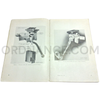
This original U.S. Army Technical Manual TM 9-1602 covers periscope mounts used with American armored-vehicle optical equipment. The basic manual was issued on September 30, 1949, and this copy has the current pages from Change 1, dated October 16, 1950, integrated into the manual. This listing is for the printed manual only; periscopes, mounts, tanks, tools, and other equipment are not included.
Manual Function and Contents
TM 9-1602 was prepared as an Ordnance Maintenance reference for personnel responsible for servicing periscope mounts. It explains the construction and operation of the equipment while providing guidance for inspection, adjustment, disassembly, assembly, maintenance, and repair. These procedures helped technicians keep mounted optical instruments secure, correctly positioned, and ready for use.
Models and Publication Details
Related Ordnance catalog records place this period mount family under Standard Nomenclature List F-312. These model references help researchers compare the manual with vehicle publications, parts catalogs, and other period fire-control records.
- Manual number: TM 9-1602
- Official subject: Ordnance Maintenance—Periscope Mounts
- Basic issue date: September 30, 1949
- Integrated update: Change 1 dated October 16, 1950
- Recorded length of the basic edition: 68 pages
- Related mount models: M66, M67, M68, M73, M83 (T130), T116, and T121
- Documented end-item applications: M4 medium tank and M26 tank
Documented End-Item Applications
Period manual indexes identify the M4 medium tank and M26 tank as end-item applications for TM 9-1602. Periscope mounts formed the mechanical connection between the vehicle and its optical equipment. Their condition and adjustment affected how securely a periscope was held and how effectively crew members could use it for observation or sighting duties.
Publication History
TM 9-1602 was published during the Army’s post-World War II effort to organize maintenance information for equipment that remained in service. Its September 1949 issue brought periscope-mount maintenance into a dedicated publication. Change 1 followed in October 1950, when World War II armored equipment was again seeing heavy operational use during the Korean War. The updated pages in this copy have already been placed into their proper locations.
Periscope Mount Equipment History
Armored-vehicle periscopes allowed crew members to observe outside while remaining behind armor. The mount held the optical instrument at its assigned crew station and provided the support needed for dependable viewing or sighting. During the 1940s, several mount patterns were developed for different crew positions and optical arrangements. Dedicated maintenance manuals became important because dirt, damage, looseness, or poor adjustment could reduce the usefulness of the mounted instrument.
M4 Medium Tank Background
The M4 medium tank, commonly known as the Sherman, became the main American medium tank of World War II. Its crew used several periscopes for protected observation and fire-control work from inside the hull and turret. M4-series tanks served in North Africa, Europe, the Pacific, and other theaters. Improved M4A3 variants remained active after World War II and returned to combat with U.S. forces during the Korean War.
M26 Pershing Tank Background
The M26 Pershing was developed as a more heavily armed and protected successor to earlier American medium tanks. Armed with a 90mm gun, it entered combat in Europe during the final months of World War II. The Pershing later served in Korea, where its armor and firepower were used against North Korean T-34 tanks and fortified positions. Its crew depended on protected optical equipment for observation, driving, target detection, and fire control.
History of Use
Manuals such as TM 9-1602 were used by trained Ordnance personnel in maintenance shops and armored units. Technicians used the instructions to inspect mount components, correct mechanical problems, make adjustments, and return equipment to service. The manual represents the support work required to keep World War II-era armored vehicles operational during the early Cold War and Korean War periods.
Ideal For
This technical manual is a useful reference for collectors, restorers, historians, and institutions studying American armored-vehicle optics and maintenance.
- M4 Sherman and M26 Pershing restorers
- U.S. Army technical-manual collectors
- Military optics and fire-control researchers
- Armored-vehicle historians
- Museums and educational displays
- World War II and Korean War collections
Approx length 6", Approx width 9", Approx height .25", Approx weight .5lbs.
Pictures are stock images of our inventory. Unless otherwise noted, you will not be receiving the exact item shown in the pictures. The pictures are representative of the item’s general condition. The item you receive might be slightly better, or worse, condition than was shown in the pictures.
Please visit our page about order lead times here: Order Lead Times.