



Description
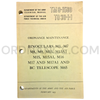
TM 9-1580 Ordnance Maintenance Manual for M3, M7, M8, M9, M13, M13A1, M15, M15A1, M16, M17, and M17A1 Binoculars and M65 BC Telescope - February 1953
Item Overview
This February 1953 edition of TM 9-1580 is an illustrated U.S. military ordnance-maintenance manual covering eleven models of binoculars and the M65 Battery Commander’s Telescope. Jointly issued by the Departments of the Army and the Air Force, the publication was prepared for personnel responsible for field and depot maintenance of military optical instruments. It documents the inspection, repair, rebuilding, testing, and adjustment methods needed to return these precision instruments to serviceable condition.
Identification and Features
TM 9-1580 combines maintenance information for a broad family of portable observation binoculars with detailed support information for the M65 BC Telescope and its associated equipment. The manual identifies the tools, fixtures, procedures, and standards used by military optical-repair personnel during the early Cold War period.
- Manual number: TM 9-1580
- Air Force technical-order number: TO 38-1-1
- Official subject: Ordnance Maintenance
- Publication date: February 11, 1953
- Issuing departments: Department of the Army and Department of the Air Force
- Covered 6x30 binoculars: M3, M8, M9, M13, and M13A1
- Covered 7x50 binoculars: M7, M15, M15A1, M16, M17, and M17A1
- Covered observation telescope: M65 BC Telescope
- Associated telescope equipment: M48 Telescope Mount and supporting tripod equipment
- Maintenance level: Field and depot maintenance
- Subjects include inspection, troubleshooting, disassembly, repair, rebuilding, assembly, testing, adjustment, and final inspection
Manual Scope and Contents
This manual addresses maintenance beyond the tools and supplies normally available to the unit operating the equipment. Its chapters cover parts, special tools, inspection of instruments in the hands of troops, ordnance-shop inspection, pre-embarkation inspection, troubleshooting, general maintenance, complete rebuilding, optical testing, alignment, adjustment, and final inspection. Separate repair chapters address the M3; M7 and M16; M8; M9; M13 and M13A1; M15, M15A1, M17, and M17A1 binocular groups. Another chapter covers maintenance and rebuilding of the M65 BC Telescope and M48 Telescope Mount.
Historical Background
The February 1953 manual replaced the March 15, 1945 edition of TM 9-1580, Technical Bulletin TB 9-1580-1 dated March 13, 1952, and portions of two earlier Ordnance technical bulletins. The revised publication added the M13A1 and M17A1 binoculars, updated maintenance information for the other listed binoculars and the M65 BC Telescope, and removed material for obsolete M2 and M6 binoculars, Type EE field glasses, and the older M1915 and M1917-series BC telescopes. These changes show how the military updated its optical-maintenance system after World War II while retaining proven equipment that remained useful.
Military Binocular Background
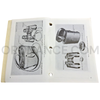
The binoculars covered by TM 9-1580 use paired prismatic telescopes connected by an adjustable center hinge. Their prism systems correct the image, increase optical length without greatly increasing instrument size, and provide the separated lines of sight needed for depth perception. The smaller 6x30 models balanced useful magnification with a compact field instrument, while the 7x50 models provided greater light-gathering ability for observation at longer ranges or in reduced light. The M3, M8, M9, M13, M13A1, M16, M17, and M17A1 included reticle patterns for measuring horizontal and vertical angles. The M7, M15, and M15A1 did not use reticles. The M13A1 incorporated improved waterproofing, while the M15A1 and M17A1 reflected modifications associated with removable M1 filters.
M65 BC Telescope Background
The M65 BC Telescope was a 10-power, 45-millimeter periscopic observation instrument developed for artillery observation and fire-control work. Its raised optical path allowed an observer to work from behind cover while viewing terrain, targets, and reference points. The telescope could be used with the M48 Telescope Mount on the M17 Tripod or with the M10 Tripod and M14 Adapter. The M28 Instrument Light supported use of the telescope’s scales under reduced-light conditions. In service, the M65 helped observers measure azimuth and angles of site, monitor target areas, and pass accurate information to fire-direction personnel.
Weapon-System and Fire-Control Background
The optical instruments in TM 9-1580 were not limited to one gun, vehicle, or weapon system. They belonged to the wider family of observation and fire-control equipment used by artillery, air-defense, armored, and other military units. Handheld binoculars helped personnel search terrain, identify targets, observe friendly and enemy movement, and correct fire. The tripod-mounted M65 gave artillery personnel a steadier and more precise observation platform. Together, these instruments supported the human observation and angle-measurement work needed before radar, electronic rangefinders, and digital fire-control systems became common.
History of Use
The equipment covered by this manual spans designs developed during World War II and improved models adopted during the early Cold War. By 1953, the Army and Air Force were maintaining a mixed inventory of proven wartime binoculars, updated A1 variants, and specialized artillery-observation equipment. Copies of TM 9-1580 were distributed to commands, divisions, ordnance units, service schools, depots, proving grounds, and arsenals. Military optical technicians used procedures like those in this manual to keep lenses clean, seals effective, reticles correctly positioned, and paired optical systems properly aligned. This work was essential because even small optical or mechanical errors could reduce observation accuracy and the usefulness of fire-control information.
Ideal For
This technical manual is well suited for collections and research focused on American military optics, ordnance maintenance, artillery observation, and the development of field equipment during World War II and the early Cold War.
- U.S. Army and Air Force technical-manual collectors
- Military binocular and optical-instrument collectors
- M65 BC Telescope owners and restorers
- Artillery and fire-control historians
- Museum reference collections and historical displays
- Military equipment researchers and preservation projects
Approx length 6", Approx width 9", Approx height .75", Approx weight 1.5lbs.
Pictures are stock images of our inventory. Unless otherwise noted, you will not be receiving the exact item shown in the pictures. The pictures are representative of the item’s general condition. The item you receive might be slightly better, or worse, condition than was shown in the pictures.
Please visit our page about order lead times here: Order Lead Times.