


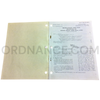

Description
Technical Manual TM 9-1440-375-35P/1 for XM4 Transportable Guided Missile Erector-Launcher – April 1968
Item Overview
This Department of the Army Technical Manual TM 9-1440-375-35P/1 covers the XM4 Transportable Guided Missile Erector-Launcher used with the Pershing I artillery guided missile system. Dated April 1968, this publication is a repair-parts and special-tools reference for the launcher and its related assemblies. It is a parts manual rather than a complete operator or repair-procedure manual.
Identification and Features
Key identifying information for this military technical manual is listed below.
- Official publication number: TM 9-1440-375-35P/1
- Equipment covered: XM4 Transportable Guided Missile Erector-Launcher
- Weapon system: Pershing I artillery guided missile system
- Publication date: April 1968
- Manual type: repair parts and special tools list
- Maintenance level: direct support, general support, and depot maintenance
- Military branch: United States Army
- Historical period: Cold War
What This Manual Covers
The -35P designation identifies this publication as a higher-level maintenance parts and special-tools manual. It was prepared to help Army personnel identify, order, and manage components needed to support the XM4 erector-launcher. Manuals of this type commonly organize parts by major assembly and provide official part names, reference numbers, supply information, and special-tool listings used by maintenance and supply organizations.
The XM4 Erector-Launcher
The XM4 performed several important jobs within the original Pershing I system. It served as a loading and missile-assembly platform, supported the missile during transportation, and helped align the missile with the required firing azimuth. At the launch site, the equipment supported missile checkout, raised the missile from its horizontal position, and provided a stable platform for launch. Period manufacturer literature identifies Unidynamics, a division of Universal Match Corporation, as the producer of the transportable erector-launcher.
How the Pershing I System Worked
Pershing I was a mobile, two-stage, solid-propellant surface-to-surface missile system. A firing unit moved the missile, launcher, power equipment, test stations, communications equipment, and other support items to a field position. Crews assembled and checked the missile, positioned the launcher, established the firing direction, and raised the missile for launch. The missile used an internal guidance system after leaving the launcher.
Application
This manual supported the maintenance and supply personnel responsible for keeping the XM4 ready for service. It helped them locate replaceable parts, identify major assemblies, select special tools, and request the correct items through the Army supply system. The publication would have been used alongside separate operator, organizational-maintenance, and repair manuals for the launcher and complete Pershing system.
Historical Background
TM 9-1440-375-35P/1 was published after the Pershing I had been in active service for several years. Its April 1968 date places it near the end of the original system’s main service period and shortly before Pershing 1a equipment began replacing Pershing I in 1969. The manual documents the established maintenance and supply system used to support the XM4 during this important transition in Army missile technology.
Pershing Weapon System History
The Pershing program began as a replacement for the Army’s older Redstone missile. Development was approved in 1958, and the system was named for General of the Armies John J. Pershing. The Martin Company received the development contract, and the first Pershing I tactical battery was activated in 1962. Pershing I was first deployed in August 1963. Pershing 1a began replacing it in 1969, followed by the longer-range Pershing II in 1983.
History of Use
Pershing I served mainly with U.S. Army units stationed in Europe and with German missile units supported through military assistance agreements. The system was assigned a Quick Reaction Alert role during the Cold War and was kept ready as part of NATO’s nuclear deterrent. Crews regularly conducted field exercises, readiness inspections, equipment drills, and test launches. Its missiles were fired for development, testing, and training, but the system was not used in combat.
Historical Significance
This manual preserves official information about the ground equipment that made the early Pershing missile system mobile and operational. It shows how the Army supported a complex guided-missile launcher at direct-support, general-support, and depot levels. The publication is also a useful record of Cold War missile logistics, field artillery operations, military supply practices, and the transition from Pershing I to later Pershing systems.
Ideal For
This military technical manual is well suited for:
- United States Army technical-manual collectors
- Pershing missile historians and researchers
- Cold War and NATO history collections
- Military vehicle and launcher researchers
- Museum reference libraries and archival displays
- Researchers studying Army missile maintenance and logistics
Approx length 8", Approx width 10", Approx height .6", Approx weight 1lbs.
Pictures are stock images of our inventory. Unless otherwise noted, you will not be receiving the exact item shown in the pictures. The pictures are representative of the item’s general condition. The item you receive might be slightly better, or worse, condition than was shown in the pictures.
Please visit our page about order lead times here: Order Lead Times.