


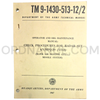

Description
April 1967 TM 9-1430-513-12/2 for the AN/MPQ-39 (XO-3) HAWK High-Power Illuminator Radar Set
Item Overview
This Department of the Army technical manual covers check procedures for Radar Set AN/MPQ-39 (XO-3), a high-power illuminator radar used with the Basic HAWK Air Defense Guided Missile System. It was issued in April 1967 for personnel working at the operator and organizational maintenance levels. The procedures helped crews check radar functions and support the readiness of the HAWK firing section. This listing is for the technical manual only; radar equipment, missiles, launchers, tools, and test equipment are not included.
Identification and Features
This Cold War manual preserves technical information for an important radar in the original HAWK missile system.
- Manual Number: TM 9-1430-513-12/2
- Publication Date: April 1967
- Equipment: Radar Set AN/MPQ-39 (XO-3)
- Radar Type: High-power illuminator radar
- Parent System: Basic HAWK Air Defense Guided Missile System
- Maintenance Level: Operator and organizational maintenance
- Manual Coverage: Radar-set check procedures
- Document Type: U.S. Army technical manual
How the AN/MPQ-39 Worked
The Basic HAWK system used acquisition radars to detect aircraft and send target information to the Battery Control Central. After a target was selected, the AN/MPQ-39 tracked it and directed continuous-wave radar energy toward it. The radar also supplied a reference signal to the HAWK missile. After launch, the missile compared that reference signal with radar energy reflected from the target, then made continuous course corrections toward the intercept point. This method is known as semi-active radar homing.
HAWK System Application
The AN/MPQ-39 served as an engagement radar within the mobile Basic HAWK battery. A period HAWK battery used two continuous-wave illuminator or high-power illuminator radars to support two firing sections. Other battery equipment included pulse and continuous-wave acquisition radars, a Battery Control Central, a range-only radar, launchers, junction boxes, generators, and missile-handling equipment. The trailer-mounted radar could be moved with the battery and set up as part of a field air-defense position.
History of Use
HAWK units were deployed to defend military forces and important locations against low- and medium-altitude aircraft. U.S. Marine Corps HAWK equipment reached Vietnam in early 1965 and protected the Da Nang area, although U.S. forces did not fire HAWK missiles in combat. The first combat use of HAWK occurred during the 1967 Six-Day War, when Israeli forces used the system against Egyptian aircraft. The AN/MPQ-39 represents the Basic HAWK period before upgraded Improved HAWK equipment, including the AN/MPQ-46 illuminator radar, gradually replaced earlier components.
Historical Background
The HAWK program began during the early Cold War as a mobile defense against aircraft flying below the most effective coverage of earlier air-defense systems. A HAWK missile destroyed an F-80 drone during a 1956 test at White Sands Missile Range, and Basic HAWK was fielded in 1960. Its mobile equipment, continuous-wave radars, and semi-active guidance made it well suited for protecting field forces. This April 1967 manual documents the AN/MPQ-39 near the end of the Basic HAWK era, while work on Self-Propelled and Improved HAWK configurations was underway.
Condition
Please check the pictures for the general condition of the item.
Ideal For
This original technical reference is well suited for:
- U.S. military technical-manual collections
- Cold War air-defense and radar research
- HAWK missile-system displays and museum archives
- Military electronics and radar-history collections
- Restoration or interpretation of surviving HAWK equipment
Approx length 8", Approx width 10", Approx height .5", Approx weight 1lbs.
Pictures are stock images of our inventory. Unless otherwise noted, you will not be receiving the exact item shown in the pictures. The pictures are representative of the item’s general condition. The item you receive might be slightly better, or worse, condition than was shown in the pictures.
Please visit our page about order lead times here: Order Lead Times.