



Description
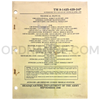
U.S. Army Technical Manual TM 9-1425-429-24P for Stinger Air Defense Guided Missile System, September 1990
Item Overview
This original U.S. Army technical manual provides repair-parts and special-tools information for organizational, direct support, and general support maintenance of the Stinger Air Defense Guided Missile System. Issued as TM 9-1425-429-24P in September 1990, it helped maintenance and supply personnel identify authorized Stinger components by illustration, stock number, and part number. NSN 1410-01-024-6938 identifies the FIM-92 guided missile associated with the system, not the paper manual or complete weapon round. This listing is for the technical manual only. It does not include a missile, launcher, gripstock, launch tube, battery-coolant unit, IFF equipment, training device, repair part, or special tool.
Publication Details
This publication belongs to the Army’s Stinger technical-manual series. The “24P” suffix identifies it as a maintenance repair-parts and special-tools list for multiple support levels.
- Manual number: TM 9-1425-429-24P
- Publication date: September 1990
- Subject: Stinger Air Defense Guided Missile System
- Publication type: Repair Parts and Special Tools List
- Maintenance scope: Organizational, direct support, and general support
- Associated missile NSN: 1410-01-024-6938
- Associated missile: FIM-92 Stinger
- Federal item name: Guided Missile, Intercept-Aerial
- Issuing authority: Headquarters, Department of the Army
- Country of origin: United States
- Item included: Technical manual only
Manual Coverage
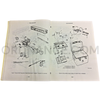
TM 9-1425-429-24P was designed to support Stinger maintenance, parts identification, and supply work. Publications of this type commonly organize components by functional group and pair written listings with exploded-view illustrations. Information may include figure and item numbers, official descriptions, National Stock Numbers, manufacturer part numbers, CAGE codes, units of issue, quantities, and maintenance-level authorization. This allowed personnel to match an illustrated component with the correct military supply record. It is a parts reference rather than an operator’s firing manual.
Stinger Equipment Identification
The Stinger system used several related assemblies with separate stock numbers. These distinctions are important because NSN 1410-01-024-6938 applies to the guided missile itself, while the missile round and complete weapon round have different numbers.
- FIM-92 guided missile: NSN 1410-01-024-6938
- Missile round: NSN 1427-01-024-9967
- Complete weapon round: NSN 1425-01-024-9982
- Gripstock-control group: NSN 1440-01-024-6931
- Launch tube assembly: NSN 1440-01-111-7791
About the Stinger Air Defense System
The FIM-92 Stinger is a lightweight, shoulder-fired air defense system made to protect troops from low-flying fixed-wing aircraft and helicopters. A complete weapon weighs about 35 pounds and uses passive homing guidance, allowing the missile to track a target after launch. The missile is supplied inside a sealed, disposable launch tube. A reusable gripstock contains the gunner’s controls and connects with the identification-friend-or-foe system. A battery-coolant unit provides temporary electrical power and cools the missile’s seeker. The system’s compact size allowed air defense teams to move with infantry, airborne, and other mobile units.
Weapon-System History
Stinger began during the late 1960s as Redeye II, a planned replacement for the earlier FIM-43 Redeye missile. The Army selected the improved design in 1971 and renamed it Stinger in March 1972. General Dynamics received the engineering-development contract later that year. The missile was designed with a reusable gripstock, improved guidance, identification-friend-or-foe capability, and better performance against aircraft approaching from different directions. Stinger was classified as a standard system in 1977, and the first production contract followed in 1978. The Basic Stinger reached initial operational capability with Army units in Europe in February 1981.
System Development by 1990
The Stinger family continued to improve after the original FIM-92A entered service. Stinger-POST added infrared and ultraviolet sensing with digital processing for better target detection and resistance to countermeasures. Stinger-RMP added a reprogrammable microprocessor so its software could be updated as threats changed. The first POST production missiles arrived in 1986, and RMP missiles followed in 1989. This September 1990 manual dates from the period when Basic, POST, and newer RMP equipment could be found within the wider Stinger support system.
History of Use
Stinger was first fielded with U.S. Army units in Europe and later reached units in Korea and the United States. Its first combat deployment by American troops came during the 1983 operation in Grenada, where 27 Stinger teams supported the airborne assault. The missile also became widely known for its effectiveness against Soviet aircraft in Afghanistan. The Stinger design was later adapted for helicopter use as Air-to-Air Stinger and for vehicle-mounted service on the Avenger air defense system. This manual was issued as Operation Desert Shield began, when Stinger-RMP and Avenger equipment were being prepared for deployment to Southwest Asia. Stinger systems also served with the Marine Corps, Navy, Air Force ground units, and many allied nations.
Collector and Research Value
TM 9-1425-429-24P is a useful reference for studying late Cold War air defense, military supply systems, missile maintenance, and the development of the FIM-92 family. Its September 1990 date connects it with the transition to Stinger-RMP and the opening months of Operation Desert Shield. The illustrated parts information can also support museum research, identification of incomplete display components, historical exhibits, and restoration of inert Stinger training equipment.
Condition
This vintage military technical manual may show cover wear, edge wear, folds, yellowing, stains, writing, stamps, punched holes, loose pages, or other signs of age and storage. Printing details, binding style, markings, and condition may vary between available copies.
Ideal For
This manual is well suited for collections, displays, and research projects covering American missile systems and short-range air defense.
- U.S. Army technical-manual collections
- FIM-92 Stinger research and displays
- Cold War air-defense collections
- Operation Desert Shield and Desert Storm exhibits
- Military repair-parts and supply research
- Inert training-equipment identification
- Museum and archival collections
Approx length 8", Approx width 11", Approx height .25", Approx weight .5lbs.
Pictures are stock images of our inventory. Unless otherwise noted, you will not be receiving the exact item shown in the pictures. The pictures are representative of the item’s general condition. The item you receive might be slightly better, or worse, condition than was shown in the pictures.
Please visit our page about order lead times here: Order Lead Times.