




Description
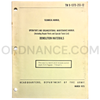
U.S. Army Technical Manual TM 9-1375-213-12 for Demolition Materials, March 1973
Item Overview
This official U.S. Army reprint of TM 9-1375-213-12 covers the operation and organizational maintenance of military demolition materials. The base manual was issued on March 30, 1973, and this edition contains current replacement pages from Changes 1 through 4. It includes repair-parts and special-tools information used to support equipment in the field. This listing is for the technical manual only. It does not include explosives, blasting caps, firing devices, demolition tools, or other equipment.
Publication Details
This publication was prepared for trained military personnel responsible for identifying, handling, operating, inspecting, maintaining, shipping, and storing authorized demolition materials.
- Manual number: TM 9-1375-213-12
- Publication date: March 30, 1973
- Subject: Demolition Materials
- Edition: Official military reprint
- Updates included: Current pages from Changes 1 through 4
- Maintenance levels: Operator and organizational maintenance
- Additional content: Repair Parts and Special Tools List
- Issuing authority: Headquarters, Department of the Army
- Country of origin: United States
- Item included: Technical manual only
Official Reprint and Change History
Army technical manuals were updated by removing older pages and inserting revised pages issued with numbered changes. This official reprint combines the March 1973 manual with pages current through Change 4, creating a working reference that reflects the first four updates without requiring separate change sheets. Changes could correct text, revise safety information, add equipment, replace illustrations, or update operating and maintenance guidance. Changes issued after Change 4 are not represented unless they were separately added to an individual copy.
Manual Coverage
TM 9-1375-213-12 provides descriptions, identification data, safety guidance, operating information, and operator-level care for a broad range of demolition equipment. Chapters address normal operation, unusual weather conditions, service upon receipt, inspection, organizational maintenance, shipment, and storage. The appendices include references, basic issue items, a maintenance-allocation chart, and organizational repair-parts and special-tools information.
Demolition Materials Covered
This is not a manual for one weapon. It documents a coordinated family of explosive charges, initiating equipment, firing devices, and support items used by Army engineers. Representative equipment covered by the manual includes the following material.
- M2, M3, M5A1, M112, and M118 block demolition charges
- TNT block charges and the M186 roll demolition charge
- Military dynamite M1
- 40-pound cratering charges
- M2A3 and M3A1 shaped demolition charges
- M183 and M37 demolition-charge assemblies
- M1A1 and M1A2 Bangalore torpedo demolition kits
- Electric and nonelectric blasting caps
- Detonating cord, time blasting fuse, and fuse igniters
- Mechanical demolition firing devices
- Blasting machines, test instruments, adapters, clips, and related tools
Historical Background
The March 1973 manual was published near the end of direct U.S. involvement in the Vietnam War and during the Cold War modernization of Army engineer equipment. It replaced the older TM 9-1375-200 dated January 28, 1964, including its changes. The new manual series separated operator and organizational duties from higher-level maintenance while bringing many older and newer demolition items into one reference. Its contents range from equipment based on World War II designs, such as the Bangalore torpedo, to postwar plastic-explosive charges and improved electrical firing equipment.
History of Use
Military demolition materials were used by trained combat engineers for obstacle reduction, wire clearing, structural cutting, bridge and fortification demolition, route cratering, construction work, and the denial of roads or facilities. Shaped charges concentrated explosive force against heavy material, while block and sheet charges could be arranged for many field jobs. Bangalore torpedoes helped open paths through wire and other obstacles. Blasting machines, caps, fuse, and detonating cord formed the supporting systems needed to initiate authorized charges. These equipment families served through the Vietnam era and remained part of U.S. engineer training and field operations during the Cold War.
Collector and Research Value
This official reprint preserves an important stage in the development of Army demolition doctrine and equipment. Pages marked Changes 1 through 4 help researchers study how military publications were corrected and expanded after their first issue. The manual is a useful reference for technical-manual collectors, military museums, combat-engineer historians, prop departments, and displays covering Vietnam-era or Cold War equipment.
Condition
This vintage military technical manual may show cover wear, edge wear, folds, yellowing, stains, writing, military stamps, punched holes, loose pages, or other signs of age and storage. Cover markings, printing details, and condition may vary between available copies. Because this is an incorporated-page reprint, some pages may carry individual change numbers.
Ideal For
This manual is well suited for historical collections, research projects, restoration references, and military-engineering exhibits.
- U.S. Army technical-manual collections
- Vietnam War and Cold War research
- Combat-engineer history displays
- Military demolition-equipment research
- Museum and archival collections
- Historical prop and exhibit references
Approx length 8", Approx width 10.5", Approx height .5", Approx weight 1lbs.
Pictures are stock images of our inventory. Unless otherwise noted, you will not be receiving the exact item shown in the pictures. The pictures are representative of the item’s general condition. The item you receive might be slightly better, or worse, condition than was shown in the pictures.
Please visit our page about order lead times here: Order Lead Times.