


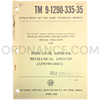


Description
U.S. Army Technical Manual TM 9-1290-335-35 for M551 Sheridan Mechanical Azimuth Indicator, April 1966
Item Overview
This U.S. Army technical manual covers direct support, general support, and depot maintenance for Mechanical Azimuth Indicator P/N 10954720, FSN 1290-901-8667. Issued on April 21, 1966, the manual supported the XM551 armored reconnaissance airborne assault vehicle, later standardized as the M551 Sheridan. This listing is for the technical manual only. It does not include an azimuth indicator, vehicle, weapon, or other fire-control equipment.
Publication Details
This higher-level maintenance publication was prepared for trained personnel responsible for keeping the Sheridan’s mechanical fire-control equipment accurate and serviceable.
- Manual number: TM 9-1290-335-35
- Publication date: April 21, 1966
- Subject: Mechanical Azimuth Indicator
- Part number: 10954720
- Federal Stock Number: 1290-901-8667
- Manual level: Direct support, general support, and depot maintenance
- Vehicle application: XM551/M551 Sheridan
- Issuing authority: Headquarters, Department of the Army
- Country of origin: United States
- Item included: Technical manual only
Manual Coverage
TM 9-1290-335-35 covers inspection, troubleshooting, disassembly, cleaning, repair, overhaul, reassembly, testing, and adjustment of the azimuth indicator. It includes procedures for the three main housing assemblies, internal gears, scales, pointers, resetter mechanism, lamp, and electrical lead. The manual also contains repair-parts information, packaging instructions, and serviceability checks. No special tools were authorized or required for repair or overhaul.
About the Mechanical Azimuth Indicator
The indicator was a mechanically driven part of the Sheridan’s turret fire-control system. Gearing connected it to the turret ring so its pointers moved as the turret turned. Graduated scales showed the main gun’s horizontal direction in relation to a selected reference point. A directional pointer was aligned with the vehicle’s lengthwise centerline during installation, while a resetter knob and movable gunner’s-aid dial helped establish and track reference settings. An internal lamp made the scales easier to read in low-light conditions.
Indicator Characteristics
The following specifications describe the azimuth indicator covered by the manual, not the physical publication offered in this listing. Its scales were marked in mils, a fine unit of angle used for military fire control.
- Construction: Three housing assemblies with gears, dials, and pointers
- Azimuth scale: 0–3200 twice, graduated every 100 mils and numbered every 200 mils
- Micrometer scale: 0–100 mils, graduated every 1 mil and numbered every 5 mils
- Gunner’s-aid dial: 0–50 twice, graduated every 1 mil and numbered every 5 mils
- Indicator height: Approximately 12 inches
- Indicator diameter: Approximately 7 inches
- Indicator weight: Approximately 24 pounds
M551 Sheridan Weapon-System History
The M551 Sheridan was developed as a lightweight armored reconnaissance and airborne assault vehicle. Its aluminum hull reduced weight, while its steel turret carried the M81-series 152mm gun-launcher. This weapon could fire conventional ammunition and the MGM-51 Shillelagh guided missile. The Sheridan could be transported by air, delivered by parachute, and prepared for amphibious movement. These features gave airborne forces mobile firepower that was difficult to provide with heavier tanks.
History of Use
The manual’s 1966 date comes from the period when the vehicle was still called the XM551. Later Army revisions changed this designation to M551 and added safety instructions for indicators fitted with certain radium-painted pointer tips. Sheridan vehicles entered combat service in Vietnam and later took part in Operation Just Cause in Panama and the Persian Gulf War. Maintenance manuals such as this one helped support the turret instruments used to keep the main gun correctly oriented during training, field operations, and combat deployments.
Collector and Research Value
This manual documents an important mechanical part of the Sheridan’s unusual gun and missile fire-control system. It is a useful reference for studying M551 turret equipment, military angular scales, Cold War fire-control design, and Army maintenance practices. It also provides valuable technical information for museums, vehicle restorers, historians, and military-manual collectors.
Condition
This vintage military technical manual may show cover wear, edge wear, folds, yellowing, stains, writing, stamps, punched holes, loose pages, or other signs of age and storage. Printing details and the presence of later change pages may vary between available copies. Please check the pictures for the general condition of the item.
Ideal For
This specialized manual is well suited for collections, research projects, restoration references, and exhibits covering American armored vehicles and Cold War fire-control equipment.
- U.S. Army technical-manual collections
- M551 Sheridan restoration and research
- Vietnam War and Cold War vehicle displays
- Military fire-control equipment collections
- 152mm gun-launcher and Shillelagh research
- Museum and archival collections
Approx length 8", Approx width 10", Approx height .2", Approx weight .2lbs.
Pictures are stock images of our inventory. Unless otherwise noted, you will not be receiving the exact item shown in the pictures. The pictures are representative of the item’s general condition. The item you receive might be slightly better, or worse, condition than was shown in the pictures.
Please visit our page about order lead times here: Order Lead Times.