


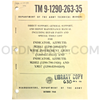


Description
U.S. Army Technical Manual TM 9-1290-263-35 for M28A1, M28E2, and XM37 Azimuth Indicators, October 1968
Item Overview
This U.S. Army technical manual covers direct support, general support, and depot maintenance for the M28A1 Azimuth Indicator, FSN 1290-346-8247; M28A1 instrument light, FSN 1260-657-8458; M28E2 Azimuth Indicator, FSN 1290-790-1926; and experimental XM37 Azimuth Indicator, FSN 1290-839-0269. Issued in October 1968, it was prepared for trained personnel maintaining armored-vehicle fire-control equipment. This listing is for the technical manual only. It does not include an azimuth indicator, instrument light, tank, weapon, or other equipment.
Publication Details
TM 9-1290-263-35 documents three related azimuth-indicator models and the instrument light used with the M28A1.
- Manual number: TM 9-1290-263-35
- Publication date: October 1968
- M28A1 Azimuth Indicator: FSN 1290-346-8247
- M28A1 Instrument Light: FSN 1260-657-8458
- M28E2 Azimuth Indicator: FSN 1290-790-1926
- XM37 Azimuth Indicator: FSN 1290-839-0269
- Manual level: Direct support, general support, and depot maintenance
- Equipment type: Mechanical fire-control instruments
- Issuing authority: Headquarters, Department of the Army
- Country of origin: United States
- Item included: Technical manual only
Manual Coverage
The “35” suffix identifies this as a higher-level maintenance publication intended for work beyond routine crew and organizational care. Its technical guidance supports inspection, troubleshooting, disassembly, cleaning, repair, reassembly, adjustment, calibration, and final testing. The October 1968 edition also records the addition of the experimental XM37 to this family of maintained equipment.
About the Azimuth Indicators
An azimuth indicator displayed the horizontal direction of a tank turret in relation to the vehicle hull or a selected reference point. Its mechanical drive was connected to turret movement, allowing the gunner to measure changes in direction as the turret turned. Coarse and fine scales provided the readings needed to lay the main gun for direction, measure horizontal angles, and return the turret to a known setting.
M28A1 Instrument Light
The instrument light covered by this manual illuminated the M28A1 dial so its scales could be read inside a darkened turret or during nighttime operations. Controlled lighting was important because the gunner needed a clear reading without creating excessive glare around other sights and controls. The light was maintained as part of the complete fire-control installation rather than as a general vehicle lamp.
M28A1 and M28E2 History
The M28A1 was used with fire-control installations found in the M48 Patton and M60 tank families. The M28E2 was a later configuration associated with the M728 Combat Engineer Vehicle and additional M60-series installations. Both models continued the Army’s use of reliable mechanical indicators as armored vehicles gained more advanced optical, electrical, and range-finding equipment.
XM37 Development
The “XM” prefix identifies the XM37 as experimental or pre-standardized equipment when this manual was published. It represents the development of a newer azimuth indicator for an advanced tank fire-control installation. Later vehicle records identify the standardized M37 with the M60A2, whose complex system combined a laser range finder, ballistic computer, optical sights, and the 152mm M162 gun-launcher.
Associated Weapon Systems
The M48 Patton family originally centered on a 90mm main gun, while later M48A5 and M60-series tanks used the 105mm M68 gun. The M728 was based on the M60 chassis and carried a 165mm M135 demolition gun for breaching and combat-engineer work. The M60A2 used a 152mm gun-launcher capable of firing conventional ammunition and MGM-51 Shillelagh guided missiles. Azimuth indicators supported these systems by giving crews an independent mechanical reading of turret direction.
History of Use
Tank crews used azimuth indicators during training, maintenance checks, and field operations. The instruments were especially important for indirect or closed-position fire, when the target could not be seen directly from the vehicle. M48A3 tanks and M728 engineer vehicles served during the Vietnam era, while the M60 family became a major part of American armored forces during the Cold War. The experimental equipment documented in this manual also reflects the technical work that led to the M60A2 of the 1970s.
Collector and Research Value
This manual is a useful reference for studying Cold War tank fire control, turret-traverse equipment, and Army maintenance practices. Its coverage of three indicator models, including the experimental XM37, makes it especially valuable for M48, M60, M60A2, and M728 research, restoration work, museum exhibits, and military technical-publication collections.
Condition
This vintage military technical manual may show cover wear, edge wear, folds, yellowing, stains, writing, stamps, punched holes, loose pages, or other signs of age and storage. Printing details and condition may vary between available copies. Please check the pictures for the general condition of the item.
Ideal For
This manual is well suited for collectors, restorers, museums, and researchers interested in American armored vehicles and mechanical fire-control equipment.
- U.S. Army technical-manual collections
- M28A1 and M28E2 restoration references
- Experimental XM37 equipment research
- M48 and M60 tank displays
- M60A2 and Shillelagh-system research
- M728 Combat Engineer Vehicle exhibits
Approx length 8", Approx width 10", Approx height .25", Approx weight .4lbs.
Pictures are stock images of our inventory. Unless otherwise noted, you will not be receiving the exact item shown in the pictures. The pictures are representative of the item’s general condition. The item you receive might be slightly better, or worse, condition than was shown in the pictures.
Please visit our page about order lead times here: Order Lead Times.