



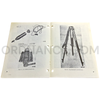

Description
U.S. Army Technical Manual TM 9-1290-262-35P for M2/T3 Aiming Circle, August 1961
Item Overview
This U.S. Army technical manual covers field-and-depot maintenance repair parts and special tools for the M2/T3 Aiming Circle. Issued as TM 9-1290-262-35P in August 1961, it was prepared for maintenance and supply personnel supporting this precision fire-control instrument. This listing is for the technical manual only. It does not include an aiming circle, tripod, protective cover, instrument light, plumb bob, weapon, or other equipment.
Publication Details
This illustrated parts publication helped military personnel identify authorized assemblies, replacement components, and special tools for the M2/T3 Aiming Circle.
- Manual number: TM 9-1290-262-35P
- Publication date: August 1961
- Equipment: M2/T3 Aiming Circle
- Federal Stock Number: 1290-614-0008
- Later NSN format: 1290-00-614-0008
- Manual type: Field-and-depot maintenance repair parts and special tools list
- Equipment class: Artillery fire-control and surveying instrument
- Issuing authority: Headquarters, Department of the Army
- Country of origin: United States
- Item included: Technical manual only
Manual Coverage
The “35P” suffix identifies this as a higher-level repair-parts and special-tools publication. Manuals of this type used numbered illustrations and matching lists to identify major assemblies, optical parts, mechanical components, hardware, accessories, and tools. It supported the field-and-depot maintenance work described in the related TM 9-1290-262-35 maintenance manual. It is mainly a parts-identification and supply reference rather than a complete operating manual.
M2 and T3 Designations
The T3 designation identifies the developmental or test-stage name associated with the aiming circle that entered standardized service as the M2. Military supply references continued to show the combined M2 (T3) identification so personnel could match earlier drawings, parts, and records with the standardized instrument. This dual designation gives the manual added value as a record of the equipment’s development and adoption.
About the M2 Aiming Circle
The M2 Aiming Circle is a portable optical and mechanical instrument used to measure precise azimuth and elevation angles from a selected reference line. Its main parts include a four-power elbow telescope, magnetic compass, graduated scales, micrometer controls, leveling screws, and spirit levels. The instrument was mounted on a tripod and carefully leveled before use. It could then establish direction, measure angles, and align indirect-fire weapons.
Equipment Features
The M2 provided unlimited azimuth rotation through a complete 6,400-mil circle. Its fixed-focus telescope offered four-power magnification and a 10-degree field of view. The instrument could measure up to 800 mils of elevation and 400 mils of depression. Circular and tubular levels supported accurate setup, while fine controls allowed the operator to make precise directional adjustments.
- Azimuth rotation: Unlimited through 6,400 mils
- Maximum elevation: 800 mils
- Maximum depression: 400 mils
- Telescope magnification: 4 power
- Field of view: Approximately 10 degrees
- Common supporting equipment: M24 tripod and M51 instrument light
Role in the Weapons System
The M2 was common fire-control equipment and was not limited to one weapon. Artillery and mortar units used it to place several guns, howitzers, or mortars on the same firing azimuth. During reciprocal laying, the aiming-circle operator and weapon crews exchanged angle readings until the weapon sights and tubes were correctly aligned. This allowed multiple weapons to deliver coordinated indirect fire even when their crews could not see the target.
Historical Background
The M2 was documented in Army service by the mid-1950s and became an important fire-control instrument during the early Cold War. This August 1961 manual appeared when the Army was expanding its mobile artillery forces and placing greater importance on rapid surveying and accurate weapon alignment. The dual M2/T3 title also preserves the connection between the instrument’s developmental designation and its standardized military identity.
History of Use
Artillery and mortar personnel used the M2 while preparing firing positions, establishing grid or magnetic direction, aligning weapons, measuring horizontal and vertical angles, and conducting field surveys. Its portable design allowed crews to operate it from permanent bases or temporary firing positions. The M2 later served alongside the improved M2A2, which increased the maximum elevation range, while the original M2 remained listed in Army publications and inventories for many years.
Collector and Research Value
TM 9-1290-262-35P is a useful reference for identifying M2/T3 Aiming Circle components and understanding the Army’s early Cold War maintenance-supply system. Its T3 reference is especially useful for studying the transition from developmental equipment to a standardized service model. The manual is well suited for military technical-publication collections, restoration research, museum exhibits, and artillery fire-control displays.
Condition
This vintage military technical manual may show cover wear, edge wear, folds, yellowing, stains, writing, stamps, punched holes, loose pages, or other signs of age and storage. Printing details and condition may vary between available copies. Please check the pictures for the general condition of the item.
Ideal For
This manual is a specialized reference for collectors, researchers, restorers, and museums interested in military surveying and indirect-fire equipment.
- U.S. Army technical-manual collections
- M2 and T3 Aiming Circle research
- Artillery and mortar fire-control displays
- Cold War military-equipment collections
- Military optics and surveying research
- Museum and archival collections
Approx length 8", Approx width 11", Approx height .2", Approx weight .2lbs.
Pictures are stock images of our inventory. Unless otherwise noted, you will not be receiving the exact item shown in the pictures. The pictures are representative of the item’s general condition. The item you receive might be slightly better, or worse, condition than was shown in the pictures.
Please visit our page about order lead times here: Order Lead Times.